


Every shot in the range is built round the same idea. A short list of functional ingredients, each doing one job, in a form your body can actually absorb.
A functional ingredient is one included for a physiological effect rather than for flavour or colour. Turmeric root, ginger, beetroot, ashwagandha and black pepper all qualify, and so do the vitamins and minerals alongside them. Seven blends use them in different proportions, from 30% turmeric root down to 0.8% ashwagandha extract.
Key takeaways
- Functional ingredients earn their place by doing something measurable, not by sounding impressive on a label.
- The percentage matters as much as the name. An ingredient listed last is usually there in a token amount.
- Black pepper appears in all seven blends because curcumin is poorly absorbed without it.
- The vitamins and minerals carry the claims with the firmest regulatory footing, and they're the least glamorous part of any label.
What are functional ingredients?
They're the parts of a food or drink included to do a job in the body, rather than to make it taste or look better.
A functional ingredient is defined as a food component added for a specific physiological benefit beyond basic nutrition. That covers plant compounds like the curcuminoids in turmeric root and the gingerols in ginger, and it covers nutrients with recognised roles, like vitamin C, magnesium, and zinc.
The useful test is whether you can say what it does and point at evidence. Turmeric root is in a shot for its curcuminoids. Beetroot is there for its dietary nitrate. Black pepper is there for piperine, which changes how much curcumin reaches your bloodstream.
The second test is quantity. Ingredients appear on a label in descending order by weight, so an impressive-sounding extract sitting near the end of the list is often present in an amount too small to matter. Percentages, where a brand publishes them, tell you far more than the name does.
What's in each blend, and why
Each shot pairs raw turmeric root with one lead functional ingredient chosen for a particular occasion.
| Blend | Lead functional ingredient | What it's there for |
|---|---|---|
| Raw Turmeric Original | Turmeric root at 30% | The everyday recovery shot, and the highest turmeric content in the range |
| Raw Turmeric & Ginger | Ginger root at 15% | Mobility support, with magnesium and vitamin C |
| Raw Turmeric & XTRA Ginger | Ginger root at 30% | The one for ginger superfans, with a chilli note in the pepper mix |
| Raw Turmeric & Beetroot | Beetroot at 19% | Performance support, for the dietary nitrate |
| Raw Turmeric & Ashwagandha | KSM-66 ashwagandha extract at 0.8% | Mind and focus support |
| Raw Turmeric & Pro-Collagen | Vegan Pro-Collagen with VeCollal® | Collagen support, with zinc and vitamin C |
| Raw Turmeric & Vitamin C & D3 | Lipoturm© blend at 9% | Immunity support through autumn and winter |
Watermelon is the base of all seven, and it isn't filler. The fresh, whole-crushed fruits carry the fat-soluble and water-soluble ingredients, bring vitamin C of their own, and make raw root drinkable in one go rather than something you brace yourself for.
We've written a page on each of the lead ingredients: ginger benefits, beetroot benefits, ashwagandha for stress and sleep, collagen benefits, and magnesium and muscle function.
Why black pepper is in every single one
Because curcumin on its own barely gets into your bloodstream, and piperine changes that.
Curcumin is poorly absorbed, rapidly processed by the liver and gut wall, and cleared quickly. A 1998 study in Planta Med, in both animals and healthy human volunteers, found that 20mg of piperine alongside curcumin raised its bioavailability by 2000% in people, with no adverse effects at the doses used. That single finding is why black pepper turns up in serious turmeric formulations and why it's in all seven of ours.
Ours is the trade-secret BioMax Uptake Blend®, which includes black pepper, and it's tuned per blend: a black pepper and chilli mix in the XTRA Ginger shot, black pepper and cinnamon in the immunity shot, black pepper, cinnamon and thyme in the ashwagandha one. There's a fuller explanation in turmeric and black pepper, and the wider absorption picture is in turmeric absorption and bioavailability.
This is also why a spoonful of turmeric powder stirred into a drink isn't the same thing. Powder is a wonderful way to cook. It isn't a route to a meaningful daily dose.
What the vitamins and minerals are doing
Carrying the claims with the firmest footing, quietly, at the bottom of the ingredients list.
Vitamin C contributes to normal collagen formation and to normal immune function. Magnesium contributes to normal muscle function and to a reduction of tiredness and fatigue. Zinc contributes to the maintenance of normal skin and nails. Vitamin D contributes to normal immune function, and the NHS recommends a 10 microgram daily supplement through autumn and winter because British sunlight is too weak from October to March.
Those are established nutrient functions, which is exactly why they're worth naming. The British Nutrition Foundation's guide to vitamins and minerals is a good place to see how they fit together across a diet.
For scale on the turmeric itself, EFSA has set an acceptable daily intake for curcumin of 3mg per kilogram of body weight, which is around 210mg a day for a 70kg adult.
What we've tested on our own blends
Two independent studies with professional footballers, run on the actual shots rather than on an extract in a capsule.
The first was a clinical trial in Frontiers in Nutrition, run by independent researchers at Nottingham Trent University with 24 elite male footballers taking two Raw Turmeric Original a day. It was the first footballer trial on these blends, and it found lower CRP at 64 hours after a match and less muscle soreness.
The second, also independent, followed 23 professional players taking one Raw Turmeric & Vitamin C & D3 a day across a season. It recorded upper respiratory illness at 3.9 versus 10.6 days per 1000 player days, along with less gut discomfort. We funded both and had no hand in the findings, and they're small studies in young athletes.
The takeaway
An ingredients list is the most honest thing on any pack. Read it in order, look for percentages, and ask what each name is actually for.
By that test, a functional ingredient earns its place when you can say what it does, show the research, and put enough of it in the bottle to matter. Raw turmeric root with black pepper alongside it is the part everything else is built around.
If you want the simplest version of the habit, Raw Turmeric Original is 30% turmeric root with the pepper mix already in it. One shot, first thing, which is when most people find it easiest to stick to.
If you take regular medication or have a diagnosed condition, run any new supplement past your GP or pharmacist first.
Frequently asked questions
What does functional mean on a food label?
It means the ingredient is there to do something in the body rather than to add flavour, colour, or bulk. The claim worth checking is what the ingredient does and how much of it is present. UK and EU rules govern which health claims a product may print, and the nutrient claims are the ones with the firmest footing.
Why is there watermelon in a turmeric shot?
Watermelon is the base of every blend and makes up between 30% and 56% depending on the shot. It carries the other ingredients, adds vitamin C of its own, and makes raw turmeric root pleasant enough to drink in one go. Raw root on its own is intensely bitter.
Do I need black pepper with turmeric?
For absorption, yes. Curcumin is poorly absorbed and cleared quickly, and piperine from black pepper raises how much reaches your bloodstream. A 1998 human study found a large increase with 20mg of piperine. Any turmeric product worth buying either includes pepper or uses another absorption technology.
Which functional ingredient should I choose?
Start from the occasion rather than the ingredient. Recovery points to Raw Turmeric Original, mobility to Raw Turmeric & Ginger, performance to Raw Turmeric & Beetroot, winter to Raw Turmeric & Vitamin C & D3, and stress or sleep to Raw Turmeric & Ashwagandha. The turmeric root and pepper mix are in all of them.
Are turmeric powder and raw turmeric root the same thing?
They come from the same plant, but they behave differently. Powder is dried and ground, and it's a flavouring, wonderful in cooking and not a practical way to take a meaningful daily amount. Raw root cold-crushed into a shot, with black pepper alongside, is a different proposition.
How long before functional ingredients do anything?
Give it three months. That's roughly how long the trials in this area run before they measure anything, it's what our own customers who stick with it tend to say, and it's a fairer test than a fortnight. Consistency does more than dose fiddling.

Raw Turmeric Original Shot Box
Our Original Turmeric Shot packs a real punch thanks to a whopping 35g of fresh raw turmeric root used to make each shot.
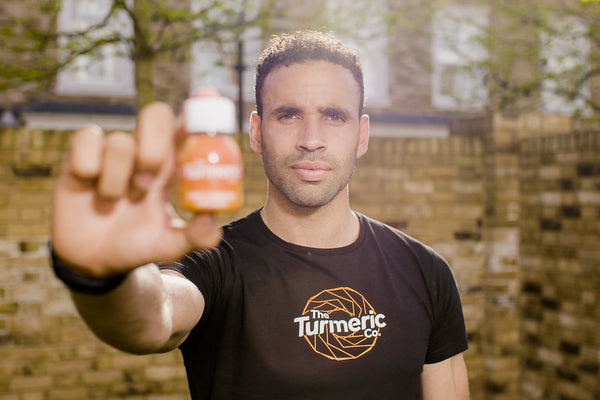
The Hal Robson-Kanu Guide To Fitness & Nutrition
Gain exclusive insight into habits that will make every day a healthy and fulfilling one.