


Magnesium is one of the most quietly important minerals for anyone who trains.
It is involved in hundreds of reactions in the body, and several of its roles are directly relevant to active people: magnesium contributes to healthy muscle function, to metabolic function, to helping your body build and repair protein and to the reduction of tiredness and fatigue... to name a few!
If you are looking at magnesium for muscles or magnesium for recovery, that combination is exactly why it earns a place in a daily routine - and why quietly running low can undermine the work you put in.
What magnesium does in a working muscle
Every muscle contraction depends on energy, and magnesium sits at the centre of how your cells produce and use it. It binds with adenosine triphosphate (ATP) - the body's main energy currency - to form the active complex that powers contraction, nerve signalling and countless other processes.
It also plays a part in relaxation: muscles need to release as well as fire, and magnesium helps regulate the calcium flux that controls both halves of that cycle. Without enough, the basic machinery of movement simply runs less smoothly.
This is why magnesium is best described as a muscle function supplement rather than a stimulant. It is not giving you an artificial lift; it is supporting processes that are already meant to happen.
Crucially for anyone training to get stronger, magnesium also contributes to normal protein synthesis — the process by which muscle actually rebuilds and adapts after a session. A comprehensive review noted that the body's need for magnesium appears to rise with physical activity, and that magnesium status has been associated with measures such as grip strength and lower-leg power.

Why active people need to watch their magnesium more closely
Here is the part most people miss: training increases both how much magnesium you use and how much you lose.
Magnesium is an electrolyte - it contributes to normal electrolyte balance - and you shed it through sweat and urine, with losses tending to rise on harder, hotter and longer sessions. Stack several heavy days on top of a diet that is already light on magnesium-rich foods, and it is easy to drift toward the lower end of comfortable.
The fatigue side of the story matters just as much.
Because magnesium helps your body release energy and reduces tiredness, keeping levels topped up can be part of feeling less drained through a heavy block - when busy schedules, broken sleep and back-to-back sessions pile up.
None of this means more is automatically better!
In people who are not deficient, magnesium supplementation does not reliably boost performance, and some trials show no clear ergogenic effect; the strongest case is for meeting your needs, not mega-dosing. Where it becomes most relevant for muscles is around soreness, where one review looked specifically at magnesium and muscle soreness across different activities — an area of growing interest, even as the picture continues to develop.
How much magnesium do you need?
In the UK, the reference nutrient intake for magnesium is around 300mg a day for men and 270mg a day for women aged 19 to 64. The figure you will see on labels (the nutrient reference value) is 375mg, which is why a product's "%NRV" is calculated against that number.
Active people sit at the demanding end of the range, but the target is very achievable from food, and you can cover it comfortably without a single animal product. Some of the richest options are plants, and they bring fibre and companion nutrients along for the ride.
Useful everyday sources include:
- Pumpkin seeds — among the densest sources, with roughly 150mg in a small 30g handful.
- Spinach and other dark leafy greens — around 80mg in a cooked portion.
- Almonds and cashews — about 75–80mg per 30g.
- Black beans, edamame and other legumes — roughly 60–120mg per portion.
- Wholegrains such as oats, brown rice and quinoa — around 40–90mg per serving.
- Dark chocolate (70% or higher) — about 65mg in a 30g square, a genuinely useful source.
The thread running through that list is whole foods eaten close to their natural state. If your diet leans heavily on processed and refined options, magnesium is one of the first nutrients to fall short, because refining strips it out.
If plants are doing the heavy lifting, you are likely closer than you think - and because magnesium is not stored in large amounts, steady daily intake beats the occasional big dose.

Magnesium, the nervous system and your daily rhythm
Recovery does not only happen in the muscle!
Magnesium also contributes to normal functioning of the nervous system and to normal psychological function — the calmer, "switch-off" side of being an active person.
After a hard session your nervous system is still revved up, and the wind-down before sleep is when much of your repair actually takes place.
Timing itself matters far less than consistency. Magnesium from food and whole-food shots is generally well tolerated and does not need to be tied to a workout, so the simplest approach is a fixed daily slot you will not forget - many people take a shot first thing, before their first meal, when the stomach is empty and absorption is at its best.
If your focus is the wind-down, the evening works equally well. There is no need to chase a perfectly timed dose around a single session; the benefit comes from keeping your overall intake topped up. Pick the time you are most likely to stick to, and let the habit do the work.
Getting it from a fresh shot, not a pill
Food first, always - but real life is busy, and consistency is where most good intentions fall down. That is where a fresh shot helps! Our cold-crushed turmeric blends layer added magnesium and vitamin C onto a base of raw turmeric root, with no preservatives, no added sugar and no ultraprocessing: a more whole-food route to a daily top-up than a synthetic tablet, and an easier habit to keep.
Several of our shots are formulated with magnesium so you can fold it into a routine you will actually stick to:
- Raw Turmeric Original — a caffeine-free daily base, naturally providing magnesium and vitamin C.
- Raw Turmeric & Ginger — added magnesium and vitamin C with the gingerols many active people reach for.
- Raw Turmeric & XTRA Ginger — the same support, dialled up, for those who want extra ginger and heat.
- Raw Turmeric & Ashwagandha — magnesium and zinc alongside ashwagandha, an evening option for winding down after training.
Take one most days, ideally before your first meal, and give it a few months.
Magnesium will not transform your training overnight, but as a foundation for normal muscle function, steadier energy and proper recovery, it is one of the most sensible nutrients an active person can keep consistent.

Raw Turmeric Original Shot Box
Our Original Turmeric Shot packs a real punch thanks to a whopping 35g of fresh raw turmeric root used to make each shot.
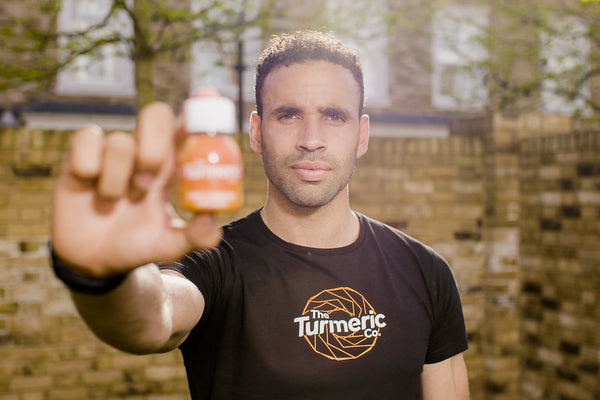
The Hal Robson-Kanu Guide To Fitness & Nutrition
Gain exclusive insight into habits that will make every day a healthy and fulfilling one.