


Curcumin's reputation rests on two kinds of evidence, lab work on cells and blood tests in people, and they answer different questions.
How does curcumin reduce inflammation? In cell studies, it blocks the signal that switches on NF-kB, a protein that turns on inflammatory genes. In people, a review of 66 randomised trials of turmeric and curcumin supplements found lower CRP and other inflammation markers in the blood, though the route through the body is still being worked out.
Key takeaways
- In cell studies, curcumin interrupts the signal that activates NF-kB, the protein behind many inflammatory genes.
- The same studies show less COX-2, an enzyme that makes prostaglandins, and less of the cytokines TNF and IL-1.
- In human trials, blood levels of CRP, TNF-alpha, and IL-6 all come down with curcumin supplements.
- Very little free curcumin reaches the bloodstream, so researchers are still working out how the lab findings connect to the trial results.
- The first clinical trial of our blends found lower CRP after matches, without looking inside cells.
How does curcumin reduce inflammation?
By interfering with the signals that tell a cell to produce inflammatory molecules, at least in the lab.
Curcumin is defined as the main curcuminoid in turmeric root, the compound behind the spice's yellow colour. Our guide to why turmeric is linked to inflammation explains what inflammation is and when it becomes a problem. This page goes a level deeper, into the machinery.
Keep the two kinds of evidence apart as you read. Cell studies show what curcumin can do to cells in a dish. Human trials show what happens to markers in the blood. Both are useful, and neither tells the whole story on its own.
What does NF-kB do?
It's a switch for inflammatory genes, and in a resting cell it's held in the off position.
NF-kB waits in the main body of the cell, bound to an inhibitor called IkB. When an inflammatory signal arrives, enzymes called IKKs mark that inhibitor for destruction. Freed, NF-kB moves into the nucleus and helps switch on genes that drive inflammation.
A 1999 study in intestinal cell lines followed this chain one link at a time. Curcumin stopped a cytokine called IL-1 beta from raising two inflammatory molecules, IL-8 and ICAM-1. It also kept the inhibitor intact, lowered IKK activity, and kept NF-kB from reaching the nucleus. The researchers placed the block upstream of IKK, which means curcumin was acting before the switch had been flipped.
Where do COX-2 and prostaglandins fit in?
COX-2 is the enzyme behind prostaglandin production during inflammation, and curcumin stopped cells from making more of it.
Researchers at the MRC Toxicology Unit at the University of Leicester tested this in a 1999 study in human colon cells. The cytokine TNF alpha would normally raise COX-2, and curcumin prevented that rise. It did so through the same chain, by inhibiting the IKKs and so protecting the inhibitor from being marked for destruction.
What happens to cytokines?
Cytokines are the proteins cells use to pass on an inflammatory message, and curcumin reduced those too.
A 1995 study in a human immune cell line exposed cells to a bacterial toxin that normally sets off a strong response. With curcumin present, the cells made less TNF and IL-1, and NF-kB activation fell. Since these cytokines also act as triggers, as the Leicester and intestinal studies show, one block upstream could plausibly have effects in several places.
All three of these studies used cells grown in the lab and exposed directly to curcumin, which matters for what comes next.
What happens in people?
Blood markers of inflammation fall, though the trials measured the blood rather than the signalling inside cells.
C-reactive protein, or CRP, is one of the blood tests the NHS uses to help measure inflammation. It's the marker most often reported, alongside the cytokines TNF-alpha and IL-6. Two large reviews have pooled the results, the 66-trial review above and a review of 32 trials in 2,038 people not receiving anti-inflammatory treatment, 28 of which could be combined.
| Blood marker | Change across 66 trials | Change across 28 trials |
|---|---|---|
| CRP | Down 0.58 mg/L | Down 1.55 mg/L |
| TNF-alpha | Down 3.48 pg/mL | Down 3.13 pg/mL |
| IL-6 | Down 1.31 pg/mL | Down 1.69 pg/mL |
The match with the lab work isn't perfect. The 66-trial review found no significant change in IL-1 beta, and the 32-trial review found no effect on ICAM-1, both of which fell in cell studies. The authors of the 32-trial review call for further work on the best dose, duration, and formulation, so the evidence is still developing, and the direction of the main markers is consistent.
Why don't lab results transfer directly?
Because cells in a dish meet curcumin directly, while cells in your body mostly don't.
Curcumin is poorly absorbed, quickly metabolised, and quickly eliminated. In a study of 12 healthy volunteers taking 10g or 12g of curcumin, only one had detectable free curcumin at any of 14 time points, though all of them had its breakdown products in their blood. That's why curcumin absorption gets so much research attention.
It also leaves an open question about how the trial results come about. One 2018 review proposes that some of curcumin's effects may begin in the gut, through its microbes, its lining, and gut inflammation, before anything reaches the blood. That's a hypothesis rather than a settled answer, but it's a promising one, and the falls in blood markers stand whichever route explains them.
Does a turmeric shot work the same way?
It hasn't been studied at the level of cell signalling, but one trial has measured inflammation directly.
Independent researchers at Nottingham Trent University ran the first clinical trial of our blends, giving Raw Turmeric Original to 16 of 24 elite male footballers while the other 8 acted as controls. CRP rose in the controls 64 hours after a match and stayed lower in the players taking the shot, who also reported less soreness. Creatine kinase didn't differ, and there was no placebo or blinding. We're clearly not a neutral party, and these were athletes under heavy load.
Raw Turmeric Original is a cold-crushed, whole watermelon-based blend with turmeric root at 30%, the most in our range, plus our trade-secret BioMax Uptake Blend®, which includes black pepper, at a 0.1% inclusion. For more on training specifically, see our guide to curcumin and exercise inflammation.
The takeaway
In the lab, curcumin interrupts the signal behind NF-kB, which turns down COX-2 and cytokines further along the chain. In people, blood markers of inflammation fall in pooled trials, and the exact route between the two is what researchers are still mapping. To make turmeric part of your morning, a Raw Turmeric Original with breakfast is an easy daily habit, and if you take prescription medicines, check with your pharmacist or GP first.
Frequently asked questions
What is NF-kB in simple terms?
It's a protein inside your cells that acts like a switch for inflammatory genes. It stays inactive until an inflammatory signal frees it from the inhibitor holding it in place.
Is curcumin an anti-inflammatory medicine?
No. It's a plant compound with anti-inflammatory activity in research, and NSAIDs such as ibuprofen are medicines. Don't swap one for the other, and keep taking anything you've been prescribed.
Can I take curcumin with anti-inflammatory medicines?
Nearly all reported interactions relate to medicinal doses or concentrated extracts, and a juiced shot carries far less curcuminoid than an extract capsule. Direct evidence on drinks is limited, so ask your pharmacist or GP before combining them regularly.
Which blood test shows inflammation?
The NHS uses CRP and a test called ESR to check inflammation levels, usually when a doctor is looking into a specific condition. Your GP can tell you whether either is useful for you.
Does cooking with turmeric reduce inflammation?
The trials tested supplements, so they don't answer that. Powder is flavour rather than function: it's a wonderful spice, and it averages about 3% curcumin, according to an analysis of 28 spice products.
Is all inflammation bad?
No. Short-lived inflammation is part of how your body responds to injury and infection. Our guide to the signs of chronic inflammation covers the longer-running kind, and what to raise with your GP.

Raw Turmeric Original Shot Box
Our Original Turmeric Shot packs a real punch thanks to a whopping 35g of fresh raw turmeric root used to make each shot.
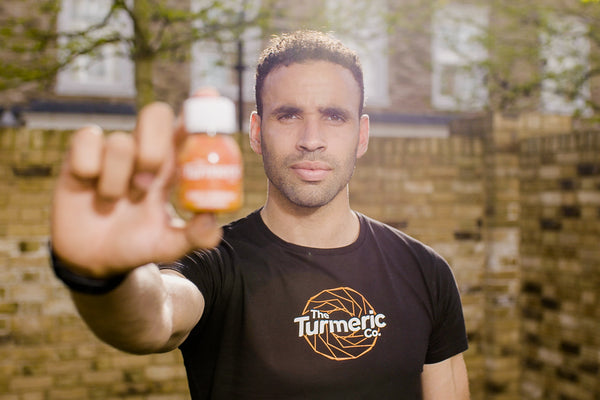
The Hal Robson-Kanu Guide To Fitness & Nutrition
Gain exclusive insight into habits that will make every day a healthy and fulfilling one.