


Curcumin absorption is the reason turmeric is complicated. The compound everyone wants is one your body is unusually good at getting rid of, and understanding how it does that explains almost every claim on a turmeric label.
Taken on its own, curcumin barely reaches the bloodstream. In the 1998 study in Planta Medica that produced the famous piperine figure, volunteers given 2g of curcumin alone had serum levels that were either undetectable or very low. That single result explains why the whole industry talks about absorption.
Key takeaways
- Curcumin's problem is not one problem but three: poor absorption, fast metabolism, and fast elimination.
- The liver and gut wall attach sugar molecules to curcumin within minutes, which is what clears it.
- Piperine, from black pepper, slows that clearance rather than helping curcumin cross the gut wall.
- The often-quoted 2000% figure comes from 20mg of piperine paired with 2g of curcumin, which is supplement-scale, not food-scale.
- Fat, a whole-root food matrix, and taking it regularly all matter more than any single number.
What limits curcumin absorption?
Three separate things, and fixing only one of them does not get you far.
A review of curcumin bioavailability in Molecular Pharmaceutics sets the problem out cleanly. Curcumin has been shown to be safe in phase I trials even at 12g a day, yet plasma and tissue levels stay stubbornly low. The reasons are poor absorption across the gut wall, rapid metabolism once it gets through, and rapid systemic elimination afterwards.
Curcumin absorption is defined as the proportion of ingested curcumin that reaches the bloodstream in a form the body can still use. On that definition the honest number for plain curcumin powder is very small, which is not a marketing problem to be spun but a chemistry problem to be worked around.
Take them in order. Curcumin is poorly soluble in water, so much of it never dissolves enough to cross the intestinal wall at all. What does cross meets enzymes in the gut wall and the liver that attach glucuronic acid and sulfate groups to it, a process called conjugation. The conjugated form is water soluble and easy to excrete, which is exactly the point from your body's perspective. And what survives that is cleared quickly.
| Stage | What happens | Why it limits you |
|---|---|---|
| In the gut | Curcumin dissolves poorly in water | Much of it never crosses the gut wall |
| Crossing the wall | Gut wall enzymes conjugate it | Modified before it reaches the bloodstream |
| In the liver | Glucuronidation continues | Converted to an easily excreted form |
| In the blood | Rapid systemic elimination | Levels fall quickly after a dose |
How does black pepper improve curcumin absorption?
By interfering with the clearance step, not by pushing more curcumin through the gut wall.
This is the detail that gets lost, and it changes how you should read a label. Piperine, the pungent compound in black pepper, is an inhibitor of glucuronidation in both the liver and the intestinal wall. It does not make curcumin more soluble. It slows down the process that removes it, so what does get absorbed hangs around longer and at higher concentration.
In that 1998 study, rats given curcumin with piperine at 20mg per kilo showed a 154% increase in bioavailability. In the human arm, 2g of curcumin with 20mg of piperine produced much higher serum concentrations between fifteen minutes and an hour after the dose, and the reported increase in bioavailability was 2000%.
That figure gets quoted constantly, including in places it does not belong, so here is the context it needs. It is a percentage increase from a very low base, which is how you get a number that large. It came from a specific pairing of 2g of curcumin with 20mg of piperine, both supplement-scale amounts. And the paper does not state how many human volunteers took part.
Does a turmeric shot deliver that much piperine?
No, and we would rather tell you that than let the number do work it cannot do.
Our BioMax Uptake Blend®, the trade-secret black pepper mix in every one of our blends, is declared at 0.1% of the bottle. That is a deliberately small inclusion, and it is nowhere near the 20mg of isolated piperine used in that study. Any brand implying a food-format drink reproduces a supplement trial's pharmacokinetics is stretching.
What a shot does offer is different, and worth having on its own terms. It delivers turmeric as whole root rather than as an isolated extract, so the curcuminoids arrive alongside the oils and other compounds naturally present in the rhizome. It arrives in a liquid, already dispersed, rather than as a dry powder that has to dissolve. And because it takes seconds, you can actually do it daily, which matters more than any single absorption figure: the trials that found benefits ran for weeks, not for one dose.
What else helps curcumin absorption?
Fat, heat, and repetition, in roughly that order of usefulness.
Curcumin is fat soluble, so taking it with some fat in the meal gives it a better chance of being carried across the gut wall. This is why traditional cooking pairs turmeric with oil or ghee, and it is the least controversial piece of advice in the whole subject.
Formulation approaches go further. The same Molecular Pharmaceutics review lists liposomal curcumin, nanoparticles, and phospholipid complexes among the routes researchers have taken to raise plasma levels. Those are pharmaceutical strategies rather than kitchen ones, and they are why an extract capsule and a whole-food drink are not really the same proposition.
Repetition is the underrated one. Because curcumin clears quickly, a single large dose produces a brief spike and then nothing. Regular smaller amounts suit the pharmacokinetics better than an occasional big hit, which is a genuine argument for a daily format.
Is more always better?
No, and there is a sensible ceiling worth knowing.
EFSA has set an acceptable daily intake for curcumin of about 3mg per kilogram of body weight per day, which works out at roughly 210mg for a 70kg adult. That is a safety reference for the purified compound rather than a target to hit, and it is a useful scale check against products offering many hundreds of milligrams of concentrated extract.
Concentrated extracts taken at high doses over long periods are also where the reported cases of digestive upset and, rarely, liver problems sit. Whole-food amounts are a different proposition. If you take prescription medicines, particularly anticoagulants or glucose-lowering medicines, speak to your pharmacist or GP before adding a concentrated extract.
The takeaway
Curcumin absorption is limited by solubility, by conjugation in the gut wall and liver, and by fast clearance, and every serious attempt to improve it targets one of those three. Piperine works on the third. Fat helps with the first. Formulation technology attacks all of them, at the cost of no longer being food.
The version we make picks the food route deliberately: whole turmeric root, already in liquid, with fruit and a black pepper mix, in a format you will actually repeat. Raw Turmeric Original carries the most turmeric in our range at 30%, which is the simplest way to make the habit part of the day rather than a project.
Frequently asked questions
Why is curcumin so poorly absorbed?
Three reasons at once: it dissolves poorly in water, enzymes in the gut wall and liver attach sugar groups to it that make it easy to excrete, and what reaches the blood is cleared quickly. Fixing one of those alone achieves little.
Does black pepper really increase curcumin absorption by 2000%?
That figure comes from one 1998 study pairing 2g of curcumin with 20mg of piperine. It is a large percentage from a very low starting point, and it describes a supplement-scale pairing rather than what a food or drink delivers.
Should I take turmeric with fat?
It helps. Curcumin is fat soluble, so some fat in the meal gives it a better chance of crossing the gut wall. It is the least disputed piece of advice on the subject, and it costs nothing to follow.
Is a curcumin extract better absorbed than turmeric root?
Extracts start with far more curcumin, and formulated versions are engineered specifically for absorption. Whole root delivers less curcumin alongside the rest of the rhizome's compounds. They are different propositions rather than better and worse.
How much curcumin is too much?
EFSA's acceptable daily intake is about 3mg per kilogram of body weight, roughly 210mg for a 70kg adult, as a safety reference for the purified compound. High-dose concentrated extracts over long periods are where problems have been reported.
Is it better to take turmeric once a day or spread out?
Curcumin clears quickly, so regular smaller amounts fit its behaviour better than one large occasional dose. More to the point, the trials that found benefits ran daily for weeks, so consistency is doing most of the work.

Raw Turmeric Original Shot Box
Our Original Turmeric Shot packs a real punch thanks to a whopping 35g of fresh raw turmeric root used to make each shot.
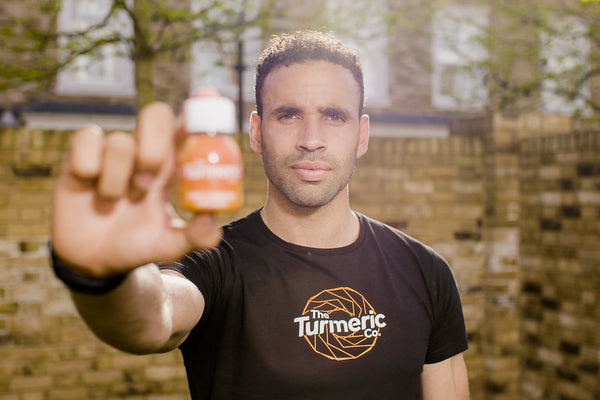
The Hal Robson-Kanu Guide To Fitness & Nutrition
Gain exclusive insight into habits that will make every day a healthy and fulfilling one.