


Blood tests after a hard match can look like something's gone wrong, when most of the time they're showing a body getting on with its repairs.
Curcumin and exercise inflammation is a story about repair: hard exercise damages muscle, and inflammatory markers rise as your body clears up. Curcumin may lower some of them, with a meta-analysis of 10 trials finding reductions in TNF-alpha and muscle soreness. Results vary between studies, and most of those studies are small.
Key takeaways
- Unfamiliar or hard exercise disrupts muscle fibres, and the inflammation that follows is part of how muscle repairs.
- Pooled trials link curcumin with lower creatine kinase, TNF-alpha, and soreness after exercise.
- In the first clinical trial of our blends, independent researchers found lower CRP 64 hours after matches in elite male footballers taking Raw Turmeric Original.
- Other studies, including a placebo-controlled trial in student footballers, found no effect, so the evidence is still developing.
- Results from elite athletes may not carry over to the rest of us.
Why does exercise raise inflammation?
Because hard exercise damages muscle, and inflammation is how your body responds to the damage.
Exercise-induced inflammation is defined as the short-term immune response to muscle damage from hard or unfamiliar training. A review of muscle damage and recovery describes what eccentric exercise does, the kind where a muscle lengthens under load: tiny changes in the muscle tissue, reduced strength and range of motion, soreness, swelling, and proteins leaking out of muscle cells.
An earlier review sets out the sequence. Mechanical disruption comes first, then white blood cells move in, and damaged tissue produces pro-inflammatory cytokines, the chemical messengers that coordinate the response. Some of this spills into the bloodstream, and it's greatest after exercise using large muscle groups, such as downhill running.
What are those markers actually measuring?
Different parts of the same clean-up, which is why they don't always move together.
C-reactive protein, or CRP, is an acute inflammatory protein made mainly in the liver, according to researchers at Manchester Metropolitan University. Creatine kinase, or CK, is used as a marker of muscle damage. TNF-alpha, IL-6, and IL-8 are cytokines.
The review above says that inflammation, once viewed as bad for recovery, is now generally accepted to be integral to muscle repair and regeneration when it's tightly regulated. A systematic review of physical activity found exercise produces a short-term inflammatory response alongside a long-term anti-inflammatory effect.
What do trials say about curcumin and exercise inflammation?
The pooled results lean positive on several markers, with enough disagreement to keep the question open.
That meta-analysis of 10 trials found curcumin significantly lowered CK and TNF-alpha, reduced soreness, and improved muscle strength and range of motion. A second meta-analysis also found lower CK and less soreness, and an umbrella review of 53 meta-analyses rated the evidence on curcumin and muscle soreness as moderate certainty.
| What was measured | What it tracks | Result with curcumin |
|---|---|---|
| TNF-alpha | An inflammatory cytokine | Down 0.22 pg/ml across pooled trials |
| Creatine kinase | Muscle damage | Down about 66 IU/L across pooled trials |
| Muscle soreness | How sore people felt | Significantly lower across pooled trials |
| CRP | Whole-body inflammation | Lower at 64 hours in the first trial of our blends |
The picture isn't uniform. The same meta-analysis found no significant change in IL-6 or IL-8. A UK-authored review of 16 papers found no statistically significant effects on muscle damage, soreness, or inflammation, and called for more research. And a randomised, double-blind crossover trial in 15 Japanese student footballers, giving 180mg of curcumin a day around a match, found no difference from placebo on any marker. The evidence is still developing, and doses and products differ from one study to the next.
For how curcumin might act on these pathways, see our guide to how curcumin reduces inflammation.
What did the first trial of our blends find?
Lower CRP and less soreness, in a pilot that was never designed to settle the question by itself.
Independent researchers at Nottingham Trent University ran the first clinical trial of our blends, with 24 elite male footballers at an English third-tier club. Sixteen drank two 60ml shots of Raw Turmeric Original a day, and the other 8 took no supplement. CRP was lower at 64 hours after matches (P=0.017), and the turmeric group reported less soreness (P<0.036).
There was no difference in creatine kinase, jump height, or strength, and the design has clear limits. There was no placebo and no blinding, and players chose their own group. We're clearly not a neutral party. A separate trial in healthy older adults is still running.
Do results from elite athletes apply to you?
Not automatically, and it's fair to say so.
Professional footballers train and compete at a level few of us reach, and competitive matches involve a kind of repeated strain that a weekly gym session doesn't. If you exercise for general fitness, the NHS guidelines of 150 minutes of moderate activity a week, or 75 of vigorous, plus strengthening on 2 days, are a very different load, and your own markers may behave differently too.
Should you try to switch inflammation off?
No. The aim of recovery is to support the process, since inflammation is part of the repair.
The muscle damage review says much less is known about how these factors affect inflammation inside the muscle and later remodelling, and that nutritional approaches have produced mixed results so far. Nobody has shown what curcumin does to long-term training gains either way. The basics still come first, as our guide to post-workout nutrition explains. If it's the ache you're trying to manage, turmeric for muscle soreness covers DOMS in detail.
When is it more than normal soreness?
When it looks like an injury. The NHS page on sprains and strains says to get help from 111 if you've had an injury and:
- it's very painful, or the pain is getting worse
- there's a large amount of swelling or bruising, or it's getting worse
- you can't put any weight on it, or can't walk more than a few steps
- it feels very stiff or is difficult to move
- it isn't feeling any better after treating it yourself
- you also have a very high temperature, or feel hot, cold, or shivery
Where does a shot fit in your training?
As a simple daily habit alongside your training, with no promise about any single session.
Raw Turmeric Original is the shot the footballers drank, and our recovery support blend. It has raw turmeric root at 30%, the most in our range, in a cold-crushed, whole watermelon-based blend with pineapple and lemon, plus added magnesium and vitamin C. It also has our trade-secret BioMax Uptake Blend®, which includes black pepper, at a 0.1% inclusion. If you take prescription medicines, speak to your GP or pharmacist before taking one regularly, since NHS Wales' medicines advisers advise caution mainly at medicinal doses, and direct evidence on drinks is limited.
The takeaway
Inflammation after hard exercise is mostly your body repairing muscle, and the markers rise for good reason. Curcumin may ease some of them, with pooled trials supporting lower TNF-alpha and CK, and independent research on our own blend finding lower CRP in elite footballers. Other trials found no effect, and elite results may not transfer to you.
If you train regularly and want turmeric in your routine, a Raw Turmeric Original each morning is an easy daily habit to pair with your sessions.
Frequently asked questions
Does curcumin reduce inflammation after exercise?
It may. A meta-analysis of 10 trials found lower TNF-alpha, and one trial in elite footballers found lower CRP at 64 hours. Other studies found no effect, so the evidence is still developing.
Why does CRP go up after exercise?
Hard exercise damages muscle, and CRP is an inflammatory protein that rises as part of the body's response. A short-term rise after a hard session is an ordinary part of that process.
Is inflammation after exercise bad?
Not in itself. A review of muscle recovery says tightly regulated inflammation is integral to muscle repair and regeneration. Long-lasting pain or swelling is a different matter, so see your GP or contact 111.
Would curcumin stop my muscles adapting?
Nobody has shown that it does or doesn't. Researchers say much less is known about how these approaches affect muscle remodelling, so this is a genuine gap in the evidence.
Do I need to be an athlete to benefit?
Much of this research is in people who train, and the first trial of our blends was in elite footballers, so results may not transfer directly. If you exercise regularly, a daily shot is an easy habit to try alongside it.
Is curcumin the same as turmeric for recovery?
No. Curcumin is the main active compound in turmeric, and most of the trials used curcumin supplements. The first trial of our blends is the exception, having tested Raw Turmeric Original.

Raw Turmeric Original Shot Box
Our Original Turmeric Shot packs a real punch thanks to a whopping 35g of fresh raw turmeric root used to make each shot.
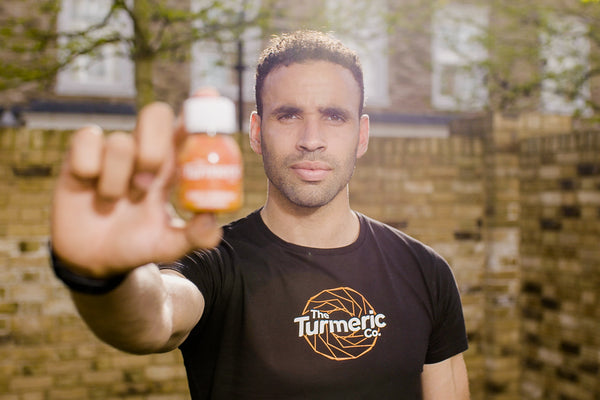
The Hal Robson-Kanu Guide To Fitness & Nutrition
Gain exclusive insight into habits that will make every day a healthy and fulfilling one.