



Turmeric for athletes started as a dressing room habit and ended up in a peer-reviewed trial. Here's what that trial found, and what it didn't.
Athletes take turmeric mainly for recovery, and the clearest evidence sits there. In a trial of 24 elite male footballers, players taking two raw turmeric shots a day showed lower CRP, a marker of inflammation, at 64 hours after a match, and reported less muscle soreness. Absorption is what separates a studied dose from a spice jar.
Key takeaways
- The best evidence for turmeric in sport is about recovery between sessions, not about making you faster or stronger on the day.
- A peer-reviewed trial in elite footballers found lower inflammation markers and less soreness after matches on two shots a day.
- Curcumin is poorly absorbed alone, so the format an athlete chooses decides whether any of it lands.
- Anyone competing under anti-doping rules should treat supplement choice as a risk decision and buy accordingly.
What does turmeric for athletes do?
It supports the recovery window between hard efforts, rather than adding anything on the day. Turmeric for athletes is defined as using turmeric, and specifically its curcuminoids, to support the inflammatory and soreness response that follows training and competition.
That distinction matters. Beetroot and caffeine are studied as performance aids you take before an event. Turmeric sits in a different category: something taken daily so that the day after a match hurts a little less and the next session is a little more useful.
Curcumin makes up only around 3% of turmeric root, and on its own it's absorbed poorly and cleared quickly. That single fact explains most of the gap between athletes who get something out of turmeric and athletes who don't.
What did the footballer trial find?
It found lower inflammation and less soreness after matches, in a small group of elite players, on two shots a day.
We partnered with independent researchers at Nottingham Trent University, who ran the study in 24 elite male footballers across a competitive period. Players taking two Raw Turmeric Original shots a day showed significantly lower CRP, a marker of inflammation, at 64 hours after a match, and reported significantly less muscle soreness. Creatine kinase, a marker of muscle damage, did not differ between groups. The paper describes each shot as delivering around 1,400mg of curcumin.
We funded that work and did not influence the findings, and it's published in Frontiers in Nutrition where anyone can read the methods for themselves. Our own write-up of it sits in clinical trial confirms the benefits of turmeric.
| What the trial measured | Result |
|---|---|
| CRP, an inflammation marker, at 64 hours post-match | Significantly lower |
| Self-reported muscle soreness | Significantly reduced |
| Participants | 24 elite male footballers |
| Dose | Two Raw Turmeric Original shots daily |
It sits alongside a wider literature rather than standing on its own.
What does the wider research on turmeric and sport show?
Pooled data across the field points the same way, with the most consistent effects on soreness and muscle damage markers.
Ten randomised controlled trials brought together in Phytotherapy Research point the same way: less soreness, lower muscle damage markers, better range of motion after hard exercise. Our guide to turmeric for muscle soreness takes that evidence apart properly.
A 2024 umbrella review in Nutrition Reviews looked across the systematic reviews of nutrition for exercise-induced muscle damage. Curcumin came out as one of the better-supported options in a category where plenty of popular products have very little behind them.
What none of this shows is a performance effect. There's no good evidence that turmeric makes you quicker, stronger, or able to go longer on the day, and we'd rather say so than imply otherwise. The value is in what happens between sessions.
Does turmeric help athletes stay available?
Availability is the quiet half of performance. The player who trains every week beats the one who is quicker but keeps missing sessions, and across a season illness takes away more sessions than soreness does.
Heavy training blocks are a recognised pressure point for the immune system, which is why squads watch coughs and colds as closely as they watch hamstrings.
We commissioned a second study on exactly that question. In 23 players taking one Raw Turmeric & Vitamin C & D3 shot a day, illness was recorded at 3.9 episodes per 1000 player days against 10.6 in the comparison group, alongside less reported gut discomfort. That study found no difference in soreness or inflammation markers, so it's telling you about availability rather than recovery. As with the recovery trial, we funded the work and had no hand in the findings.
That shot is built around vitamin C and vitamin D, both of which contribute to the normal function of the immune system, with ginger and pomegranate alongside the raw turmeric root.
A third piece of our research looked at menstrual symptoms in six sub-elite female footballers taking one Raw Turmeric & Ginger shot a day, and reported physical symptom severity around 10% lower. Six players is a pilot rather than a finding, and it's the direction we're funding work in next.
How do professional squads use it?
Daily, in a fixed slot, as one small part of a nutrition plan built by people whose job that is.
Our founder, Thomas Robson-Kanu, made the first version of this formula at home as a professional footballer dealing with injuries that were stalling his career. Twenty years on, the same approach is in the fridges of more than 15,000 people across the UK, and the brand works with professional clubs and governing bodies across football, rugby, and gymnastics. Our posts on the England Rugby League partnership and the AFC Wimbledon recovery partnership set out what those look like in practice.
The pattern in those setups is consistent, and it's less exciting than people expect! It's taken every day rather than saved for match days, it's taken in a form with absorption support built in, and it sits on top of sleep, food, and load management rather than in place of them.
What turmeric won't do, and what to check before you take it
It won't compensate for poor sleep, under-eating, or a training block that ramps too fast. The British Dietetic Association is blunt on this in its sport and exercise nutrition guidance: supplements don't make up for poor food choices, though they can help in specific situations.
If you compete under anti-doping rules, supplement choice is a risk decision. Contamination, not the labelled ingredient, is the usual problem. The BDA's guidance on supplements is a sensible starting point, and your governing body or a registered sports dietitian should be the ones signing off what goes in your kit bag.
Format matters as much as brand. Whole raw root is the thing to look for, because shots built from turmeric juice, powder, or concentrate can carry fewer of the compounds the trials were measuring. In whatever form, it's important to check whether the turmeric source has been tested for heavy metals (good quality brands will be able to account for this), and check the base isn't propped up with concentrated apple or orange juice.
Turmeric powder from the spice rack is a different product altogether. Excellent for cooking, unreliable as a meaningful daily dose of recovery support, because it's dried and ultra-processed with no absorption support built in.
The takeaway
Turmeric earns its place in an athlete's routine for one specific job: making the days after hard efforts a bit more manageable, so the next session is a better one. It won't make you faster, and any product that says it will is overselling.
The trial that matters most here didn't use a capsule or a spoon of spice. It used two shots a day of raw root with a measured amount of black pepper, which is the only reason any curcumin got where it needed to go. Raw Turmeric Original is that shot, cold-crushed rather than cooked down, with the pepper already in it. The fresh fruit carries the nutrients and brings benefits of its own, which concentrated juice cannot claim.
If your sport is heavy on impact and your joints take the load, Raw Turmeric & Ginger is the one to reach for. Take one a day, through a full block, and judge it on how the day after feels.
If you're managing an injury or taking medication, speak to your GP or team doctor before adding anything.
Frequently asked questions
Does turmeric improve athletic performance?
There's no good evidence that turmeric makes you faster or stronger on the day, and we'd rather be straight about that. What the research supports is recovery: less soreness and lower inflammation markers after hard efforts, which over a season means better quality sessions. Treat it as a recovery habit, not a pre-event aid.
What did The Turmeric Co. footballer study actually show?
Independent researchers at Nottingham Trent University studied 24 elite male footballers taking two Raw Turmeric Original shots a day. Players showed significantly lower CRP, an inflammation marker, at 64 hours after a match, and reported significantly less muscle soreness. Creatine kinase did not differ. It's published in Frontiers in Nutrition, so the methods are there to read.
How much turmeric should an athlete take?
Follow the serving on the pack rather than improvising, and take it daily instead of only around competition. Trials in this area have generally used daily supplementation over weeks. For scale rather than as a target, EFSA's acceptable daily intake for curcumin is about 3mg per kilo of body weight, which is roughly 210mg for a 70kg adult, and refers to the purified additive.
Is turmeric safe for drug-tested athletes?
Turmeric itself isn't a banned substance, but the real risk with any supplement is contamination during manufacture rather than the labelled ingredient. If you're tested, check products through your governing body's guidance and speak to a registered sports dietitian before adding anything. The British Dietetic Association's supplements guidance is a good place to start.
When should athletes take turmeric, before or after training?
Daily consistency matters far more than timing, so pick a slot you'll keep on rest days as well as training days. Many players take theirs with breakfast, where a little fat in the meal supports absorption. There's no strong evidence that dosing immediately post-session beats simply taking it every day.
Can I get the same effect from curry or turmeric powder?
Not reliably. Curcumin is only around 3% of turmeric root, powder is dried and ultra-processed, and without black pepper and some fat alongside it very little is absorbed. Powder is a genuinely good cooking ingredient, but the trials in athletes used concentrated raw root with absorption support built in, which is a different thing entirely.
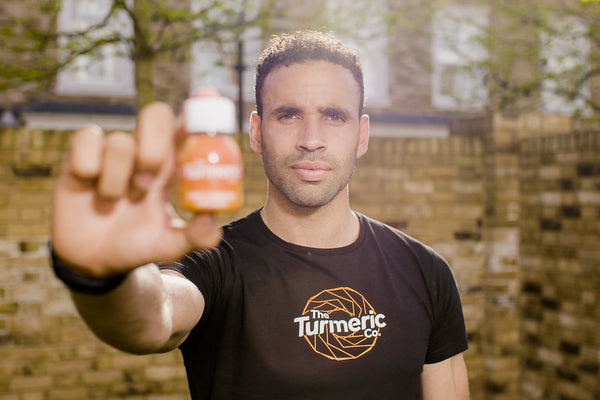
The Hal Robson-Kanu Guide To Fitness & Nutrition
Gain exclusive insight into habits that will make every day a healthy and fulfilling one.