


Turmeric for muscle soreness gets talked about a lot, and the trials are more interesting than the hype. Here's what DOMS is, and where turmeric fits.
Delayed onset muscle soreness peaks roughly 24 to 72 hours after unfamiliar or eccentric training. A 2022 dose-response meta-analysis of ten randomised controlled trials found curcumin supplementation reduced reported soreness and creatine kinase, a marker of muscle damage. It's a supportive effect on top of the basics, not a way to skip them.
Key takeaways
- DOMS comes from the lowering, braking part of movement, and it's a normal part of adapting to new training rather than a sign you've done something wrong.
- Pooled trial data supports curcumin for reduced soreness and lower muscle damage markers, with the clearest results when it's taken daily rather than as a one-off.
- Absorption decides everything. Curcumin without black pepper or fat mostly passes through you.
- Sleep, enough protein, and easing into new loads still do the heavy lifting. Turmeric goes on top of that, not instead of it.
What is DOMS, and why does it happen?
DOMS is defined as the muscle pain and stiffness that appears a day or two after exercise your body isn't used to, rather than during the session itself. If it hurts while you're training, that's something else.
It follows eccentric work in particular: the lowering half of a squat, the downhill section of a run, the controlled part of a press-up. Those movements create microscopic disruption in the muscle, and your body mounts an inflammatory repair response.
That response is the point. It's how the tissue comes back better prepared for the same load next time. The soreness is a side effect of a useful process, which is why the goal is to take the edge off rather than shut it down.
Soreness usually climbs for a day, peaks somewhere between 24 and 72 hours, and fades within about five days. Pain that's sharp, sudden, or accompanied by swelling is a different matter, and the NHS covers when a strain needs looking at.
Does turmeric for muscle soreness work?
Taken together, the trials say it helps a moderate amount, and the effect is most reliable on how sore you feel rather than on how fast strength returns.
The strongest single piece of evidence is a systematic review and dose-response meta-analysis in Phytotherapy Research, which pooled ten randomised controlled trials and found curcumin supplementation lowered muscle soreness ratings, reduced creatine kinase, and improved range of motion after damaging exercise.
A controlled trial published in the European Journal of Applied Physiology reached the same conclusion on pain, and saw some signal on recovering muscle performance.
A 2024 umbrella review in Nutrition Reviews looked across the systematic reviews of nutritional interventions for exercise-induced muscle damage, and curcumin comes out as one of the better-supported options in a field where a lot of popular supplements have thin evidence.
Independent research on The Turmeric Co. blends points the same way: elite footballers on two shots a day reported less soreness after matches, with lower inflammation markers three days out. We funded that work and did not influence the findings.
| What the trials looked at | What they found |
|---|---|
| Reported soreness after damaging exercise | Consistently reduced across the trials |
| Creatine kinase, a muscle damage marker | Lowered |
| Range of motion | Improved |
| Speed of strength recovery | Some signal, less consistent |
| Preventing DOMS altogether | Nothing does this |
How much turmeric do you need for soreness, and in what form?
Enough curcumin to matter, paired with something that helps you absorb it, taken every day rather than only after a hard session.
Curcumin makes up only around 3% of turmeric root, and on its own it's poorly absorbed and cleared quickly. Piperine from black pepper is what turns that around, slowing the clearance so more of the curcumin stays available to you. The research that first measured it found the difference was substantial, and it's the reason our trade-secret BioMax Uptake Blend® goes into every shot rather than being left to chance.
Fat matters too, since curcumin is fat-soluble. Taking yours alongside breakfast gives it a lift.
Most trials in this area dosed daily for a stretch of weeks, and several started supplementing before the damaging session rather than after it. That's the practical takeaway: a daily habit beats a reactive one.
This is also where turmeric powder falls down for soreness, while staying excellent for cooking. It's dried and ultra-processed, curcumin is a small fraction of what's in the jar, and there's usually no pepper or fat alongside it. Good for a curry, unreliable as a meaningful daily dose of recovery support.
Not every shot is built the same way, so the label is worth two minutes of your time. Whole raw root is what you want. Turmeric juice, powder, or concentrate can mean fewer of the compounds the trials were measuring… and if ‘turmeric juice’ is what's listed, steer clear!
Our turmeric dosage guide covers amounts properly, and turmeric bioavailability goes deeper on absorption.
What else reduces muscle soreness?
The unglamorous things, and they matter more than any supplement.
Easing into new movements is the single most effective one. The first session of anything unfamiliar will hurt most, and the same session a fortnight later barely registers. That's your body adapting, and it's completely free!
Sleep is where most of the repair happens. Protein spread across the day gives your body the raw material, and the British Dietetic Association's sport and exercise nutrition guidance sets out sensible amounts for active people.
Gentle movement on sore days tends to help more than sitting still. A walk, an easy spin, some light mobility work. Static stretching before training has a poor record for preventing soreness, so don't rely on it.
| Approach | How much it helps with DOMS |
|---|---|
| Building load gradually | The most effective thing you can do |
| Sleep and enough protein | Foundational, hard to overstate |
| Light movement on sore days | Helpful for how you feel |
| Daily curcumin with pepper and fat | Modest, supported by pooled trials |
| Static stretching beforehand | Poor evidence for preventing soreness |
The takeaway
You can't train your way around DOMS, and you wouldn't want to, because the soreness is attached to the adaptation you're training for. What you can do is take the edge off it and get back to the next session in better shape.
Get the basics right first. Then, if you want something extra with real trial data behind it, turmeric is a sensible pick, provided you take a form your body can actually absorb and take it daily.
A jar of powder asks you to remember, measure, and find something to stir it into. Raw Turmeric Original asks you to open a bottle, and it's the shot the footballers in that trial were given. If your sessions leave your joints as sore as your muscles, Raw Turmeric & Ginger is the one to reach for. Drink one a day and judge it over a training block, not a weekend.
If soreness is severe, one-sided, or isn't settling after a few days, see your GP rather than reaching for a supplement.
Frequently asked questions
Does turmeric help with DOMS?
The benefit is real but moderate. A 2022 meta-analysis of ten randomised controlled trials found curcumin supplementation reduced reported soreness, lowered creatine kinase, and improved range of motion after damaging exercise. It takes the edge off rather than removing soreness, and it works best taken daily rather than only after a hard session.
How long does it take for turmeric to help with muscle soreness?
Think in weeks, not hours. The trials in this area supplemented daily over a period rather than dosing once after exercise, and several began before the damaging session. If you want a fair test, take it every day through a full training block and judge it then.
Should I take turmeric before or after a hard session?
Daily is what matters most, so build it into a slot you'll keep. Several trials started supplementation in the days before the damaging exercise rather than after it, which supports treating turmeric as an ongoing habit rather than a post-session rescue. Taking it with a meal that has some fat in it helps absorption either way.
How much turmeric should I take for muscle soreness?
Stick to the serving on the pack of whatever you're using. For scale rather than as a target, EFSA's acceptable daily intake for curcumin is around 3mg per kilo of body weight, roughly 210mg for a 70kg adult, and that refers to the purified additive rather than whole root. If you're on medication or managing a health condition, check with your GP first.
Is turmeric better than ice baths or stretching for soreness?
They're doing different jobs, and the evidence quality differs. Static stretching has a weak record for preventing DOMS. Cold water immersion can make you feel better short term, though there's ongoing debate about whether regularly icing after training dampens the adaptation you're chasing. Daily curcumin with proper absorption support has randomised trial data behind it and doesn't interfere with your training.
Can I just use turmeric powder from the spice rack?
For cooking, absolutely, and it's a lovely ingredient. As a route to a meaningful daily dose of recovery support it doesn't hold up, because it's dried and ultra-processed, curcumin is only a small share of the root, and there's no black pepper or fat built in to help you absorb it. Fresh versus powdered turmeric sets the two side by side.

Raw Turmeric Original Shot Box
Our Original Turmeric Shot packs a real punch thanks to a whopping 35g of fresh raw turmeric root used to make each shot.
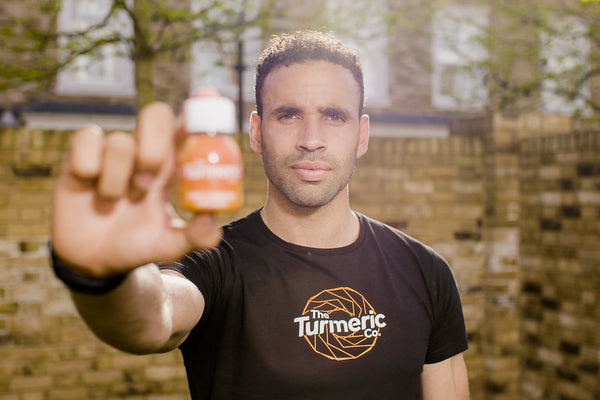
The Hal Robson-Kanu Guide To Fitness & Nutrition
Gain exclusive insight into habits that will make every day a healthy and fulfilling one.