


There's no official recommended daily amount for turmeric. But research, safety reviews and a bit of common sense point to some sensible ranges.
There's no official daily dose of turmeric, because it's a food rather than an essential nutrient. As a safety reference, the European Food Safety Authority sets an acceptable daily intake for curcumin of 3mg per kilo of body weight, about 210mg a day for a 70kg adult. For everyday use, a moderate, food-like amount taken with black pepper matters more than chasing a big milligram number.
"How much turmeric should I take?" is one of the most common questions people ask, and the honest answer is that it depends on what you're taking and why. Turmeric is a food first and a supplement second, so it doesn't come with the kind of fixed daily figure you'd find for, say, vitamin C. Here's how to think about it sensibly.
Key takeaways
- There's no official daily dose of turmeric. It's a food first, so amounts are guided by safety limits and common sense.
- EFSA sets an acceptable daily intake for curcumin of 3mg per kilo of body weight, about 210mg a day for a 70kg adult.
- Trials often use much higher, supervised doses of extract. Everyday use looks gentler and more food-like.
- Consistency and good absorption matter more than chasing a big milligram number.
Why is there no official turmeric dosage?
Because turmeric is a spice, there's no recommended daily allowance for it in the way there is for essential nutrients.
Arthritis UK points out that turmeric is generally well tolerated, with only minor side effects reported in trials. That's reassuring, but it isn't a target. It tells you what's generally fine, not what you specifically need.
So instead of one magic number, it helps to look at a few reference points.
What the safety reviews say
The clearest formal figure comes from food-additive safety work.
The European Food Safety Authority's 2010 re-evaluation set an acceptable daily intake for curcumin of 3mg per kilogram of body weight per day. For a 70kg adult, that works out at roughly 210mg of curcumin a day. It's worth being clear that this figure refers to curcumin as a purified additive, and it's a safety ceiling for everyday intake rather than a therapeutic recommendation.
Still, it gives you a useful sense of scale for the concentrated compound.
How much turmeric do studies use?
Research studies tend to use higher, targeted amounts of curcumin extract than you'd get from food.
Trials looking at joint comfort have often used several hundred to a couple of thousand milligrams of curcumin a day. A safety review in Phytotherapy Research reports curcumin being tolerated at up to 6g a day for four to seven weeks in human studies. These are study conditions, usually supervised, and not a template to copy at home without advice.
The takeaway is that trial doses are deliberately high and specific. Everyday use looks different.
What happens when people take two shots a day?
One study worth knowing about used our own shots.
In a 2023 pilot published in Frontiers in Nutrition, researchers at Nottingham Trent University gave elite footballers two Raw Turmeric Original shots a day, described in the paper as containing about 35g of raw turmeric root each, an estimated 1,400mg of curcumin, with black pepper. The players taking turmeric had less muscle soreness and lower C-reactive protein, a marker of inflammation, after matches than those who didn't, and settled back towards their baseline faster. A marker of muscle damage, creatine kinase, showed no clear difference between the groups.
We're not a neutral party here, and it's a small, early study in fit young athletes under heavy training, so it isn't a prescription for everyone. Still, it's a useful signal: two shots a day is a food-like amount that some people find worthwhile when recovery and everyday inflammation are the priority.
You can read the full pilot study for the detail.
How much turmeric is in a shot?
When you're using the whole root rather than an isolated extract, the numbers work differently.
A raw turmeric shot delivers the whole root in liquid form. Our Raw Turmeric Original shot is a concentrated measure of raw turmeric root, which gives you the curcumin alongside the plant's natural oils and other compounds. Cooking with the powder adds smaller amounts, closer to a gram or two per generous serving.
Whole-root amounts are gentler and food-like, which is part of their appeal for daily use.
Here are the main reference points side by side:
| Context | Typical amount | What it means |
|---|---|---|
| EFSA acceptable daily intake (curcumin) | ~3mg/kg, about 210mg for a 70kg adult | Safety ceiling for the purified additive, not a target |
| Study doses (curcumin extract) | Several hundred to ~2,000mg a day | Supervised trial conditions, not a home template |
| Raw turmeric shot | A concentrated whole-root measure | A food-like whole-root amount for daily use |
| Cooking with powder | Roughly 1 to 2g per generous serving | Small amounts, mostly for flavour |
Does a higher dose mean more benefit?
Chasing a high milligram figure misses the point if your body can't absorb it.
Curcumin is poorly absorbed on its own, so pairing it with black pepper and a little fat does more than simply increasing the dose. Our guide to turmeric absorption explains why a smaller, well-absorbed amount can beat a large one that mostly passes straight through.
Consistency beats intensity here. A moderate daily amount, taken well, tends to serve people better than an occasional large one.
Who should be careful with turmeric?
A few people should be more cautious with turmeric, especially in concentrated supplement form.
That includes anyone who is pregnant or breastfeeding, people with gallstones or bile duct problems, and anyone taking blood-thinning medication or approaching surgery. If that's you, talk to your doctor before starting. Our guide to turmeric side effects covers this in more detail.
The takeaway
There's no perfect daily dose of turmeric, but there is a sensible approach. Start modest, take it with pepper and food, keep it regular, and treat very high supplement doses as something to discuss with a professional.
For most people, a daily whole-root shot is the practical middle ground: enough turmeric to matter, in a food-like form your body can absorb, with the black pepper already in the blend. If recovery is your focus, the pilot study above is one reason some people step up to two shots a day. Get the habit right, and the exact milligram count matters far less than you'd think.
Frequently asked questions
How much turmeric should I take per day?
There's no official number, because turmeric is a food rather than an essential nutrient. A sensible approach is a moderate, food-like amount taken daily with black pepper and a little fat. A raw turmeric shot is one easy way to keep that consistent, while cooking adds smaller amounts.
How much turmeric is too much?
As a reference point, EFSA's acceptable daily intake for curcumin is 3mg per kilo of body weight, roughly 210mg a day for a 70kg adult, though that figure is a safety ceiling for the purified additive rather than a target. Very high supplement doses are best discussed with a doctor, especially if taken for a long time.
Can I take turmeric every day?
For most people, yes. Whole-root, food-like amounts suit daily use, but some groups should take care, which our guide to turmeric side effects covers.
Is a bigger dose better?
Not usually. Curcumin is poorly absorbed on its own, so a smaller, well-absorbed amount taken with pepper and fat can do more than a large dose that mostly passes straight through. Consistency beats intensity.
How much turmeric is in a teaspoon of powder?
A level teaspoon of turmeric powder is roughly 2 to 3g, and because curcumin is only about 3% of it, that works out at a fairly small amount of the active compound. That's why cooking is more about flavour than a meaningful dose, and why a raw shot delivers far more turmeric in a food-like form.

Raw Turmeric Original Shot Box
Our Original Turmeric Shot packs a real punch thanks to a whopping 35g of fresh raw turmeric root used to make each shot.
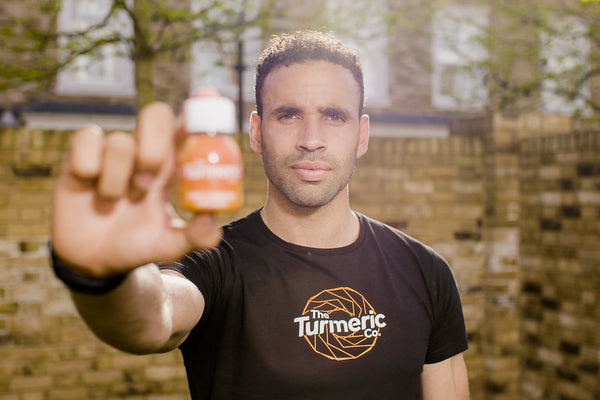
The Hal Robson-Kanu Guide To Fitness & Nutrition
Gain exclusive insight into habits that will make every day a healthy and fulfilling one.