


Turmeric for joints is one of the most searched health questions in the UK, and one of the few with a decent evidence base behind it. Here's what it supports, and what it doesn't.
Turmeric is studied for joint comfort because curcumin, its main active compound, appears to influence the inflammatory pathways involved in joint pain. A 2024 review pooling earlier meta-analyses found curcumin eased osteoarthritis symptoms across trials. It sits alongside the things that treat the underlying problem, never instead of them.
Key takeaways
- The evidence is strongest for osteoarthritis of the knee, where several pooled analyses report less pain and better function.
- Movement, strength work, and keeping to a healthy weight do more for your joints than any supplement, and that is not a throwaway line.
- Curcumin is poorly absorbed on its own, so the form you take it in decides whether you get any of it.
- Turmeric supports comfort. It doesn't treat arthritis, and it never replaces the care your GP or rheumatology team gives you.
What does turmeric for joints do?
It may take the edge off joint pain and stiffness. It doesn't repair cartilage, slow the disease, or fix the mechanics underneath.
Turmeric for joints is defined as using turmeric, and specifically its curcuminoids, to support comfort and mobility in aching or stiff joints. That's a narrower claim than most of the internet makes, and it's the one the research actually supports.

Curcumin makes up only around 3% of turmeric root. That single fact explains most of the gap between people who feel something and people who don't, and we come back to it below.
Why do joints hurt in the first place?
Usually because of wear to the cartilage that cushions them, an injury, or an inflammatory condition where the immune system attacks the joint lining.
Osteoarthritis is the common one. The NHS describes it as the most prevalent form of arthritis in the UK, where cartilage thins and the joint becomes painful and stiff, most often in knees, hips, and hands.
If it's the inflammatory side you want explained rather than the joint itself, how turmeric works on inflammation covers the mechanism.
Rheumatoid arthritis is a different beast entirely. It's an autoimmune condition, it needs proper medical treatment, and the NHS guidance on it is the place to start rather than a wellness article.

Then there's the everyday kind: joints that ache after a hard session, a long walk, or a day on your feet. That's usually load rather than disease, and it tends to settle.
Knowing which one you're dealing with matters, because turmeric is a reasonable addition to the third and a small supporting act in the first. It is not an answer to the second.
What does the research on turmeric and joints show?
Consistent, modest improvements in osteoarthritis pain and function, with the knee the most studied joint by some distance.
A 2024 review in Phytotherapy Research pulled together the existing meta-analyses on curcumin and osteoarthritis, and found the overall picture supports reduced pain and improved function. Pooling reviews rather than single trials is a decent guard against one flattering study skewing the picture.
Looking specifically at the knee, a systematic review and meta-analysis of randomised controlled trials in Current Rheumatology Reports concluded turmeric extracts improved symptoms with a reassuring safety profile.
Arthritis UK counts more than 20 clinical trials of turmeric and curcumin in arthritis, and makes the same point we keep making about absorption: the better-absorbed preparations are the ones that tend to show something.
| Question people ask | Where the evidence stands |
|---|---|
| Does it ease osteoarthritis knee pain? | Best-supported use, across pooled trials |
| Does it improve joint function and stiffness? | Supported, alongside the pain findings |
| Does it rebuild cartilage or slow the disease? | No evidence supports this |
| Does it help rheumatoid arthritis? | Not a substitute for medical treatment. Speak to your team |
| Is it well tolerated day to day? | Generally yes, with minor digestive effects in some people |
Getting turmeric into a form your body can use
Whole raw root with black pepper, taken daily and with a little fat, beats a spoon of powder by a distance.
Curcumin is fat-soluble and cleared by your digestive system quickly. Piperine from black pepper slows that clearance, and the widely repeated 2000% figure traces to one small study of ten volunteers in 1998, so treat the number as an early signal while the principle behind it holds.

This is where powder earns an honest place and where it doesn't. Turmeric powder is a lovely cooking ingredient. It isn't a reliable route to a meaningful daily dose of joint support, because it's dried and ultra-processed and comes with none of the absorption help built in.
For scale rather than as a target, EFSA's acceptable daily intake for curcumin is about 3mg per kilo of body weight, roughly 210mg for a 70kg adult, and that refers to the purified additive. Our turmeric dosage guide goes through amounts properly.
What helps your joints more than turmeric does
Moving them. It feels counterintuitive when they hurt, and it's still the strongest advice in UK clinical guidance.
NICE's guideline on osteoarthritis (NG226) puts therapeutic exercise and weight management at the centre of care, not at the edges. Muscle around a joint takes load off it, and the NHS strength and flexibility guidance is a sensible starting point.

Swimming and cycling are kind to knees and hips while still building strength. Our piece on whether yoga helps joint pain covers the gentler end.
Turmeric goes on top of all that. Anyone selling it as a replacement for movement is selling you something!
The takeaway
If your joints ache, start with the things that carry the most evidence: move them regularly, build the muscle around them, manage your weight if that's a factor, and see your GP about pain that's persistent, swollen, or waking you at night.
Then, if you want a daily habit with real trial data behind it, turmeric is a fair choice. The only question that matters is whether you'll take it consistently in a form your body absorbs, because a jar of powder in the cupboard has never helped anyone's knees.
Not every turmeric shot is built the same way, and it's worth reading the label: shots made from turmeric juice, powder, or concentrate rather than the whole raw root can carry fewer of the compounds the trials measured. Raw Turmeric & Ginger is the one we'd point you to here. It's a cold-crushed, watermelon-based blend of ginger and raw turmeric root with pomegranate, magnesium, and vitamin C, and our trade-secret BioMax Uptake Blend®, which includes black pepper, so the absorption side is handled. The fresh, whole-crushed fruits in it carry the nutrients and bring benefits of their own, which is more than concentrated apple or orange juice does. The gingerols in ginger have their own long association with supporting you through stiff mornings. One a day, given a proper run of weeks rather than judged after three days.
If you're on blood thinners, managing a diagnosed condition, or your pain is getting worse, talk to your GP before adding anything.
Frequently asked questions
Does turmeric really help joint pain?
For osteoarthritis, pooled trial data supports modest improvements in pain and function, and the knee is the best-studied joint. It won't repair cartilage or change the course of the condition. Treat it as a daily habit that may make things more comfortable, on top of exercise and the care your GP arranges.
How long does turmeric take to work for joints?
Weeks rather than days. Trials in this area typically run for eight to twelve weeks of daily supplementation before measuring anything. Give it a couple of months of consistent daily use before deciding, and keep taking it on the days your joints feel fine. Our guide to how long turmeric takes to work covers the timelines.
Can I take turmeric with arthritis medication?
Ask your GP or pharmacist first, particularly if you take blood thinners, since turmeric may affect clotting. Never stop or reduce prescribed medication to try a supplement instead. Turmeric is something you add alongside your treatment, with your team's knowledge, not something you swap in.
Is turmeric better than glucosamine for joints?
They've been studied differently, and neither is a cure. Curcumin has the more consistent recent evidence for osteoarthritis pain, while glucosamine's trial record is mixed and UK guidance doesn't recommend it routinely. If you're weighing options, your GP knows your history and is better placed than a comparison table.
How much turmeric should I take for joint pain?
Follow the serving on the pack of whatever you use, and take it daily rather than only on bad days. For scale rather than as a target, EFSA's acceptable daily intake for curcumin is about 3mg per kilo of body weight, roughly 210mg for a 70kg adult. If you're managing a health condition, check with your GP first.
Will turmeric powder in my cooking help my joints?
It's a genuinely good ingredient and worth using, but as a route to a meaningful daily dose of joint support it falls short. Curcumin is only a small share of the root, powder is dried and ultra-processed, and without black pepper and a little fat very little is absorbed. Fresh versus powdered turmeric compares the two forms directly.

Raw Turmeric Original Shot Box
Our Original Turmeric Shot packs a real punch thanks to a whopping 35g of fresh raw turmeric root used to make each shot.
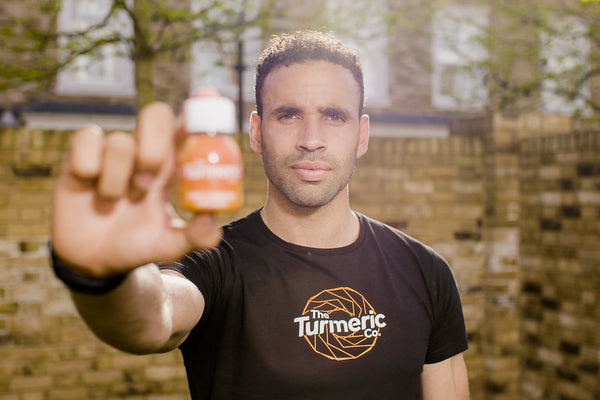
The Hal Robson-Kanu Guide To Fitness & Nutrition
Gain exclusive insight into habits that will make every day a healthy and fulfilling one.