


Curcumin half life sounds like a technical detail and is actually the most practical thing you can know about turmeric, because it explains why once-a-day thinking is probably the wrong shape for it.
The circulating forms of curcumin have a half-life of roughly seven hours. In a pharmacokinetic study in healthy volunteers given a single 10 to 12 gram dose, the estimated half-life was 6.77 hours, with peak levels at about 3.3 hours. That shape, a slow rise and a steady fall, is what a dosing routine should be built around.
Key takeaways
- The half-life of curcumin's circulating conjugates is about seven hours, with a peak around three hours.
- At 10 to 12 grams, free curcumin was undetectable in almost every participant. What circulates is conjugates.
- A single daily dose leaves a long stretch with very little in your system.
- Splitting the amount across the day fits the pharmacokinetics better than one large hit.
- None of this changes the fact that consistency over weeks is what the outcome trials actually measured.
Curcumin half life: what does the human data show?
About 6.8 hours for the conjugated forms found in blood, with the peak arriving around three hours after a dose.
Half-life is defined as the time taken for the concentration of a substance in the blood to fall by half. It is the number that tells you how long an effect can plausibly persist, and how often you would need to take something to maintain a level.
The clearest human figures come from that pharmacokinetic study, which gave twelve healthy volunteers a single oral dose of either 10 or 12 grams and sampled their blood at fourteen points over 72 hours. Time to peak was 3.29 hours. Half-life was 6.77 hours. Peak concentrations were 2.30 and 1.73 micrograms per millilitre for the two doses.
There is a detail in there that reframes everything. Using an assay able to detect 50 nanograms per millilitre, only one of the twelve participants had detectable free curcumin at any time point. Everyone had curcumin glucuronides and sulfates. In other words, even at ten grams, what reaches your bloodstream is almost entirely the conjugated, metabolised form rather than curcumin itself.
| Measure | Value from the human study |
|---|---|
| Time to peak concentration | About 3.3 hours |
| Half-life of circulating conjugates | About 6.8 hours |
| Dose given | 10g and 12g, single oral dose |
| Participants with detectable free curcumin | 1 of 12 |
| Glucuronide to sulfate ratio | Roughly 1.9 to 1 |
Why does the half life matter practically?
Because it tells you that a once-daily habit leaves most of the day uncovered.
Work the arithmetic through. If levels peak at three hours and halve every seven, then by twelve hours after a dose you are down to roughly a third of the peak, and by twenty-four hours to under a tenth. A single morning dose means the evening and overnight hours have very little circulating.
Whether that matters depends on what you think the effect depends on, and honestly nobody knows. If the benefit tracks peak concentration, one bigger dose might be better. If it tracks sustained exposure, splitting is better. The inflammatory processes turmeric is studied against operate continuously, which is a reasonable argument for spreading it, and it is the same logic behind why our own footballer trial used two shots a day rather than one.
It is a reasonable inference rather than a proven dosing strategy, and we would rather label it as such.
Does the conjugate finding undermine the whole thing?
It complicates the story, and it does not erase the results.
This is worth confronting directly. If what circulates is mostly conjugated curcumin, and conjugates are generally less biologically active than the parent compound, how do the outcome trials produce results at all?
Several explanations are plausible and none is settled. Conjugates may be deconjugated back to free curcumin in tissues. The gut itself may be a site of action, since most curcumin never leaves it. Curcumin's metabolites may have activity of their own. Or the effects may be smaller than headline claims and the trials are detecting something modest, which is broadly what the pooled meta-analyses on pain and inflammatory markers suggest.
What this genuinely rules out is the simplest story, the one where you swallow curcumin, it circulates as curcumin, and it acts on tissues as curcumin. That version does not survive the pharmacokinetics.
How does absorption interact with this?
Piperine extends the exposure rather than raising the ceiling, which is a half-life story more than an absorption one.
Piperine inhibits glucuronidation, the process that converts curcumin into its excretable form. Slowing that step means what has been absorbed lingers longer and at higher concentration. So black pepper is acting on the elimination half of the equation.
Every blend we make carries BioMax Uptake Blend®, our trade-secret black pepper mix, declared on the label at 0.1%. That is a small inclusion by design and nothing like the isolated piperine amounts used in pharmacokinetic studies, and we would rather say so than imply our shots reproduce a supplement trial's blood curve. Our guide to curcumin absorption sets out the full mechanism.
So what should you actually do?
Take it daily, split it if that is easy, and stop optimising past that point.
One scale check before any of that. EFSA's acceptable daily intake for curcumin is about 3mg per kilogram of body weight a day, roughly 210mg for a 70kg adult, as a safety reference for the purified compound. The 10 and 12 gram doses in that pharmacokinetic study were experimental amounts used to make curcumin measurable at all, not a suggestion.
Here is the honest hierarchy. Consistency over weeks matters most, because that is what every outcome trial actually tested. Taking it with fat matters next, because curcumin is fat soluble. Splitting the amount across the day is a reasonable third, supported by the pharmacokinetics rather than by outcome data. Everything beyond that is speculation dressed as precision.
Our guide to the best time to take turmeric covers the timing question in practical terms, and how long turmeric takes to work covers the longer runway that actually determines whether you notice anything.
The takeaway
Curcumin half life is around 6.8 hours for the conjugates that circulate, peaking near three hours, and free curcumin is barely detectable in blood even at ten gram doses. That argues for spreading a daily amount rather than taking it all at once, and it argues against expecting a single dose to cover a whole day.
It also argues for a format you can repeat without thinking. Raw Turmeric Original carries turmeric root at 30%, the most in our range, and two a day is exactly what the footballers in our own research took.
Frequently asked questions
How long does curcumin stay in your system?
The circulating conjugates have a half-life of about 6.8 hours, so levels fall to roughly a third of peak by twelve hours and under a tenth by twenty-four. Peak arrives around three hours after a dose.
Should I take turmeric once or twice a day?
The pharmacokinetics favour splitting, since a single dose leaves a long uncovered stretch. It is a reasonable inference rather than a proven strategy, and consistency matters far more than the split.
Why is free curcumin not detectable in blood?
Because the gut wall and liver conjugate it almost immediately, attaching glucuronide or sulfate groups. Even at 10 to 12 gram doses, only one of twelve participants in the study had detectable free curcumin at any time point.
Does black pepper change curcumin's half life?
That is essentially what it does. Piperine inhibits glucuronidation, the step that clears curcumin, so what is absorbed persists longer. It acts on elimination rather than on getting more across the gut wall.
Does a longer half life mean better results?
Not necessarily, because nobody has established whether the benefit tracks peak concentration or total exposure. It is a reasonable argument for spreading a daily amount, not a demonstrated improvement in outcomes.
How long before I notice anything?
Weeks, not hours, and the half-life has nothing to do with it. The outcome trials ran from four to thirty-six weeks. Give any turmeric habit eight to twelve weeks before deciding whether it is doing anything.

Raw Turmeric Original Shot Box
Our Original Turmeric Shot packs a real punch thanks to a whopping 35g of fresh raw turmeric root used to make each shot.
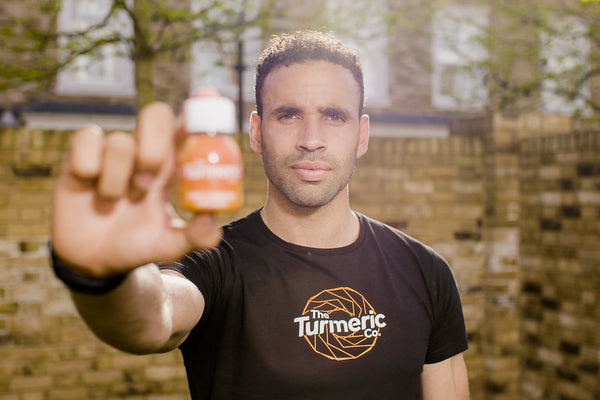
The Hal Robson-Kanu Guide To Fitness & Nutrition
Gain exclusive insight into habits that will make every day a healthy and fulfilling one.