


Curcumin and gut microbiome is one of the most confidently asserted claims in the supplement aisle, and it rests on a surprisingly small amount of human data, which is worth knowing before you buy anything on the strength of it.
There is essentially one human trial. A double-blind, randomised, placebo-controlled pilot study gave turmeric or curcumin to healthy volunteers and sequenced their gut bacteria. It found changes, and it involved 14 people in total. That is the whole human evidence base, and it should shape how confidently anyone talks about this.
Key takeaways
- Human evidence for curcumin changing the gut microbiome is one pilot study of 14 people.
- In that study, response was highly individual: some people changed a lot, others not at all.
- The mechanism is plausible, because most curcumin never leaves the gut in the first place.
- Almost all the supporting work is in cells and animals, which often does not translate.
- Treat microbiome claims on any product as a hypothesis rather than a demonstrated benefit.
What does the research on curcumin and gut microbiome actually show?
One small pilot found changes in bacterial diversity, with a striking amount of variation between individuals.
The study is worth describing properly, because the detail is the point. It gave turmeric tablets with piperine to six people, curcumin with piperine to five, and placebo to three. Gut bacteria were sequenced before and after. Across participants, between 172 and 325 bacterial species were detected.
The placebo group showed an overall 15% reduction in species detected. The turmeric group showed a modest 7% increase. The curcumin group showed an average 69% increase. Among the participants who responded, both turmeric and curcumin shifted the microbiota in a highly similar way, with increases across a range of genera and reductions in most Ruminococcus and several Blautia species.
Here is what has to be said alongside those numbers. Fourteen people is a pilot, not a finding. Three people in a placebo arm cannot establish a baseline. Everyone's microbiota varied significantly over time regardless of treatment. And the authors themselves described the response as highly personalised, with clear responders and non-responders.
| What the pilot reported | The caveat that goes with it |
|---|---|
| Curcumin group: 69% more species detected | n = 5 |
| Turmeric group: 7% more species detected | n = 6 |
| Placebo group: 15% fewer species | n = 3 |
| Responders showed a consistent signature | Non-responders showed no change at all |
Why would curcumin affect gut bacteria at all?
Because most of it never gets absorbed, which turns a weakness into the mechanism.
This is the genuinely interesting part, and it is well established even though the microbiome outcome is not. Curcumin is poorly absorbed: it dissolves badly in water, and what does cross the gut wall is rapidly conjugated and cleared. In a pharmacokinetic study giving healthy volunteers 10 to 12 grams in a single dose, free curcumin was detectable in only one participant across 14 blood samples.
So where does the rest go? It stays in the gut, in contact with the bacteria living there, for hours. A compound with antioxidant and antimicrobial activity sitting in the colon at high local concentration is a plausible reason to expect microbial effects, and it is a better argument than anything based on blood levels.
That logic also explains why the microbiome is one of the few areas where curcumin's poor absorption might be an advantage rather than the problem it is everywhere else.
What about all the other studies?
Almost all of them are in cells or in mice, and that is a real limitation rather than a technicality.
There is a substantial body of animal work showing curcumin altering gut bacterial populations, strengthening the intestinal barrier, and reducing markers of gut inflammation. It is consistent and it is suggestive. It is also not evidence about humans, and the microbiome is a field with a long record of mouse findings that did not survive contact with people.
We would rather set that out plainly than list a dozen rodent studies as though they settled the question. Where the evidence is thin, saying so is more useful than filling the gap with confidence.
Does any of this connect to our own research?
Indirectly, and the honest link is about the gut lining rather than about bacteria.
Independent researchers ran a study on 23 professional footballers taking one Raw Turmeric Vitamin C & D3 shot a day through a competitive season. Alongside fewer days of upper respiratory illness, 3.9 against 10.6 per 1,000 player days, the players reported less gut discomfort and showed a lower blood level of I-FABP, a marker released when the intestinal lining is under stress. We paid for that research and had no hand in the findings.
That is a measurement of gut barrier stress, not of the microbiome, and we are not going to blur the two. It is a small study in young athletes under heavy training load. It sits alongside the microbiome question rather than answering it.
What should you actually take from this?
That the mechanism is plausible, the human evidence is thin, and neither of those facts is a reason to buy or avoid anything.
If a product claims to support your gut microbiome, the honest position is that this has been tested in humans once, in fourteen people, with individual responses varying enormously. That is not nothing, and it is a long way from a demonstrated benefit.
What is better supported is the wider picture: fibre, variety of plants, and fermented foods have far stronger evidence for gut health than any single compound. The NHS guidance on getting more fibre into your diet is a more reliable route to a healthier gut than anything in a bottle. Our guide to turmeric and gut health covers the reader-level version of that, including where turmeric does and does not fit.
If you take prescription medicines, or you have an inflammatory bowel condition, speak to your pharmacist or GP before adding a concentrated supplement.
The takeaway
Curcumin and gut microbiome research is at the pilot stage in humans, and the one trial that exists covered fourteen people with wildly individual responses. The mechanism makes sense precisely because curcumin is badly absorbed and lingers in the gut, which is the one context where that is useful. Anything stated more confidently than that is running ahead of the data.
Turmeric is worth having for reasons that are better evidenced than this one. Raw Turmeric Original carries turmeric root at 30% as whole root in a cold-crushed blend, which is a good daily habit whatever the microbiome research eventually shows.
Frequently asked questions
Does curcumin change your gut bacteria?
One pilot study in 14 people found changes in bacterial diversity, with large differences between individuals and clear non-responders. That is the entire human evidence base, so the honest answer is that it might, in some people.
Why is curcumin thought to affect the microbiome?
Because most of it is never absorbed. It stays in the gut in contact with bacteria for hours, which is a plausible route to a local effect and a better argument than anything based on blood levels.
Is turmeric a prebiotic?
Not in the established sense. Prebiotics are compounds that selectively feed beneficial bacteria, and turmeric has not been shown to do that in humans. Dietary fibre has far stronger evidence for that role.
Is a turmeric shot good for gut health?
The gut lining evidence is more encouraging than the microbiome evidence. Our own footballer study found less reported gut discomfort and a lower marker of intestinal lining stress, in a small group of young athletes.
What actually helps the gut microbiome?
Dietary fibre, a wide variety of plants, and fermented foods have the strongest evidence by a distance, and NHS guidance on fibre is the practical place to start. A single compound is unlikely to outperform eating thirty different plants a week.
Should I take curcumin for IBS or IBD?
Speak to your GP first. Those are diagnosed conditions with their own treatment pathways, and a supplement is not a substitute. Some trial evidence exists for specific conditions, but it needs interpreting alongside your own care.

Raw Turmeric Original Shot Box
Our Original Turmeric Shot packs a real punch thanks to a whopping 35g of fresh raw turmeric root used to make each shot.
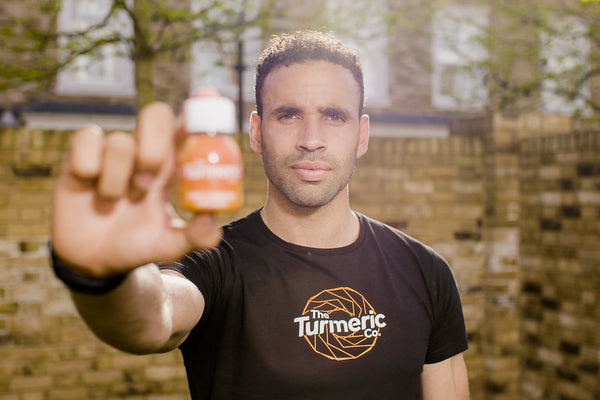
The Hal Robson-Kanu Guide To Fitness & Nutrition
Gain exclusive insight into habits that will make every day a healthy and fulfilling one.