


Turmeric has been studied more than almost any other kitchen spice. Here's what that research genuinely supports, and what's still an open question.
Turmeric's best-supported benefit is around joint comfort: reviews of randomised trials show that curcumin, the compound making up about 3% of the root, can ease knee osteoarthritis pain compared with placebo. Most other uses, from heart health to mood, are still early or mixed, so turmeric is best seen as steady daily support rather than a cure.
Search "turmeric benefits" and you'll find claims for everything from sore knees to sharper memory. Some of it is grounded in real research, and plenty of it runs well ahead of the evidence. This is an honest look at where turmeric actually stands, a well-studied plant with a few areas of genuine promise and a lot still being worked out.
Key takeaways
- Turmeric's strongest evidence is for joint comfort. Most other uses are still early or mixed.
- Curcumin, about 3% of the root by weight, is the compound behind most of the research.
- Curcumin is poorly absorbed on its own, so black pepper and a little fat matter as much as the dose.
- Turmeric works best as steady, everyday support, not a quick fix or a replacement for medicine.
What is turmeric, and how does curcumin fit in?
Turmeric is the golden root of the Curcuma longa plant, a relative of ginger. Its most studied compound is curcumin, which gives the root its colour and makes up only about 3% of it by weight.
Curcumin is defined as the main curcuminoid in turmeric, carrying most of its studied activity. It belongs to a group called curcuminoids, and it's the part most of the research focuses on. If you want the full picture on how the two relate, our guide to curcumin vs turmeric covers it in detail.
The short version: when a study talks about turmeric's effects, it's usually looking at curcumin.
Which turmeric benefits have the strongest evidence?
We’ve said it once and we’ll say it again - if turmeric has a headline act, it's joint comfort.
A 2025 systematic review and network meta-analysis of randomised controlled trials found that turmeric preparations significantly reduced WOMAC pain scores, a standard measure used in knee osteoarthritis research, compared with placebo. Separate trials of low-dose turmeric extract have reported similar improvements in pain and function over several weeks.
Arthritis UK takes a more measured view, pointing out that there's only limited trial evidence in osteoarthritis, so we don't yet know how effective turmeric really is. That's a fair summary. Promising, not proven.
Here's how the evidence stacks up across the main areas turmeric is studied for:
| Area | What the evidence shows |
|---|---|
| Joint comfort (knee osteoarthritis) | Strongest: reviews of randomised trials show reduced pain versus placebo |
| General inflammation | Plausible mechanism, promising but not settled |
| Heart, mood, gut and metabolic health | Early and mixed, no firm conclusions yet |
| "As good as" a named medicine | Not supported by human evidence |
Inflammation is the common thread
Most of turmeric's studied effects trace back to one idea: curcumin appears to influence the body's inflammatory pathways.
A safety and pharmacology review in Phytotherapy Research describes turmeric's therapeutic interest as resting largely on its anti-inflammatory activity, which is why researchers have looked at it for conditions where inflammation plays a role. Because so many everyday aches and longer-term health issues involve inflammation, that single mechanism is behind a lot of the interest.
We've looked at this ourselves, too. In a 2023 pilot study published in Frontiers in Nutrition, run with Nottingham Trent University, elite footballers who took two Raw Turmeric Original shots a day had less post-match muscle soreness and lower C-reactive protein, a blood marker of inflammation, than a comparison group, and recovered towards baseline faster. We're clearly not a neutral party about our own products, and it's a small, early study in athletes rather than proof for everyone, so we hold it lightly. But it points the same way as the wider research on turmeric and inflammation.
It's worth being careful here, though. Activity in a lab or a short trial doesn't automatically translate into a benefit you'll feel day to day, but combining this research with the 1000s of positive reviews we have gives us real confidence in the role turmeric can play as part of a consistent daily wellness routine.
Areas researchers are still exploring
Beyond joints, turmeric is being studied for heart health, mood, gut health and metabolic markers. The results so far are mixed and mostly early.
The UK takes a cautious approach to natural remedies, but the regulatory framework has not always kept pace with emerging research. That doesn’t mean turmeric should be presented as a cure, but it does mean the absence of an authorised claim isn’t the same as an absence of evidence.
That doesn't make the research uninteresting. It just means the honest word is "studied", not "proven".
The bigger claims, kept in proportion
You'll also see turmeric billed as a match for named medicines, or as a treatment for memory loss, low mood, cancer, and weight gain. Those headlines usually trace back to laboratory studies or early animal work, not the large human trials you'd want before leaning on something for your health.
So when you see turmeric described as working “as well as” a particular painkiller or antidepressant, it is worth keeping the bigger picture in mind. Some human trials have shown positive results, but the evidence is still developing and is not yet strong enough to make that comparison confidently. Turmeric should not replace treatment recommended by your doctor, and if a symptom is bothering you, that conversation still comes first.
Why does absorption matter so much?
One reason results vary so much comes down to a practical problem. Curcumin is poorly absorbed on its own.
Taken alone, very little of it reaches your bloodstream. Black pepper helps a great deal: a much-cited 1998 study in human volunteers found that piperine, the active compound in black pepper, increased curcumin absorption substantially. Fat helps too, since curcumin is fat-soluble.
This is why how you take turmeric can matter as much as how much. Our guide to turmeric absorption goes deeper on the practical side.
How should you take turmeric day to day?
You don't need a laboratory dose to enjoy turmeric as part of a balanced routine.
Adding fresh root to meals and taking a raw shot both count, especially when paired with black pepper and a little fat. The key is regularity rather than the odd big hit.
Our Raw Turmeric Original shot is made from raw blended root with our BioMax Uptake Blend®, a black-pepper blend, so the curcumin arrives in the whole-food form it's naturally found in. If you're focused on staying mobile and active, Raw Turmeric & Ginger pairs two roots studied for the same reasons.
The honest takeaway
Turmeric isn't a cure, and it won't change anything overnight. What it is, is a genuinely well-researched plant with real promise for joint comfort and a broader story that's still being written.
If you'd like to give it a fair go, keep it consistent, take it with pepper and food, and judge it over weeks rather than days. That's the approach the evidence quietly supports.
Frequently asked questions
What are the proven benefits of turmeric?
The strongest evidence is for joint comfort, where reviews of randomised trials have found turmeric preparations reduce knee osteoarthritis pain compared with placebo. Most other uses, from heart health to mood, are still early or mixed, so turmeric is best described as studied rather than proven.
Does turmeric actually reduce inflammation?
Curcumin, turmeric's most studied compound, appears to influence the body's inflammatory pathways, which is why researchers look at it for conditions where inflammation plays a role. Activity in a lab or a short trial doesn't guarantee a benefit you'll feel day to day, so it's fair to call this promising rather than settled.
Is turmeric as effective as anti-inflammatory medication?
It's too early to say. Some human trials have shown positive results, but the evidence is still developing and is not yet strong enough to make that comparison confidently. Turmeric should not replace treatment your doctor has recommended, so if a symptom is bothering you, that conversation still comes first.
How long does turmeric take to work?
Turmeric rewards consistency over weeks rather than days, so it's best judged over a month or more of daily use taken with black pepper and a little fat. Our guide to how long turmeric takes to work goes into detail.
What is the best form of turmeric to take?
The evidence points to consistency and good absorption more than any single format, so the best form is the one you'll take daily with black pepper and a little fat. A raw whole-root shot keeps the curcumin alongside the plant's natural oils and makes the daily habit easy to keep, which is what turns turmeric from a good intention into a routine.

Raw Turmeric Original Shot Box
Our Original Turmeric Shot packs a real punch thanks to a whopping 35g of fresh raw turmeric root used to make each shot.
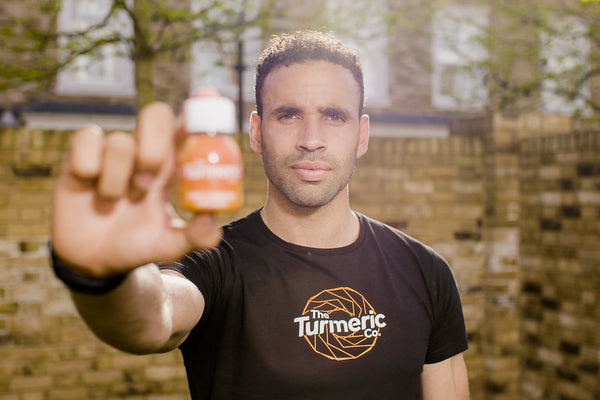
The Hal Robson-Kanu Guide To Fitness & Nutrition
Gain exclusive insight into habits that will make every day a healthy and fulfilling one.