


Turmeric and diabetes medication is a combination worth thinking about properly, and the reason is straightforward: curcumin appears to lower blood glucose, and so does your prescription.
Two things that lower blood sugar can add up. A meta-analysis of 18 trials in 1,382 people with type 2 diabetes found curcumin lowered fasting blood glucose by about 0.6 mmol/L and HbA1c by 0.54 percentage points. Those are meaningful numbers, which is exactly why the combination deserves a conversation.
Key takeaways
- Curcumin has a measurable glucose-lowering effect, so it works in the same direction as your medication.
- The realistic risk is hypoglycaemia, not a dangerous chemical clash.
- Most reported interactions involve medicinal doses or concentrated extracts, not turmeric in food and drink.
- Never stop, reduce, or change a prescribed diabetes medicine on your own.
- Speak to your pharmacist, GP, or diabetes team before adding turmeric as a daily habit.
Does turmeric affect blood sugar?
Yes, and the evidence is more solid than for most of turmeric's claimed effects.
The 18-trial analysis above is the clearest picture available. Across 1,382 people with type 2 diabetes, average age 55.9, curcumin supplementation significantly reduced fasting blood glucose, by 11.48 mg/dL in the units the paper uses, which is roughly 0.6 mmol/L on a UK meter. HbA1c fell by 0.54 percentage points, and C-reactive protein, an inflammation marker, fell too.
An HbA1c reduction of half a percentage point is not trivial. It is the sort of change a clinician would notice and act on. That is genuinely encouraging as a finding, and it is precisely the reason this article exists: an ingredient with a real effect on blood glucose is an ingredient that interacts with medicines designed to do the same job.
Supporting that, a randomised placebo-controlled trial in 84 people with prediabetes in Phytotherapy Research gave curcumin at 500mg a day for 90 days and found improvements in fasting glucose, post-meal glucose, HbA1c, insulin, and insulin resistance against placebo.
What is the real risk with turmeric and diabetes medication?
Hypoglycaemia. Your blood sugar going lower than intended, rather than anything toxic happening.
This is the honest framing, and it is less alarming and more practical than the internet usually manages. Curcumin is not dangerous alongside metformin, gliclazide, or insulin in the sense of a chemical reaction. The issue is additive effect. If your medication is titrated to hold your glucose in a target range, and you add something that independently lowers glucose, you can end up below that range.
The NHS guidance on low blood sugar sets out what hypoglycaemia feels like and what to do about it. The risk is highest with medicines that actively drive glucose down, such as sulfonylureas like gliclazide, and insulin. Metformin on its own rarely causes hypoglycaemia, so the concern there is smaller, though still worth raising.
| Medicine type | Examples | Why it matters here |
|---|---|---|
| Sulfonylureas | Gliclazide, glimepiride | Actively lower glucose, so additive effects matter most |
| Insulin | All types | Dose is matched to intake, so anything that shifts glucose matters |
| Metformin | Metformin | Rarely causes hypoglycaemia alone, but still worth mentioning |
| SGLT2 inhibitors, DPP-4 inhibitors | Empagliflozin, sitagliptin | Lower hypoglycaemia risk alone, still your prescriber's call |
How much turmeric are we actually talking about?
This is where the dose distinction does most of the work, and it is the honest point as well as the reassuring one.
Nearly all reported or theoretical interactions relate to medicinal doses of turmeric, or to concentrated curcumin extract supplements, rather than to dietary turmeric. The Welsh Medicines Advice Service guidance on turmeric interactions, reviewed by NHS Wales, notes that curcumin may lower blood glucose and that people taking glucose-lowering medicines should be aware of the hypoglycaemia risk. It also says clinicians should weigh the nature and the dose of the product in front of them.
That matters because the trials above used isolated curcumin at supplement doses, typically hundreds of milligrams a day. Our shots are cold-crushed whole-food blends carrying far less curcuminoid than an extract capsule, and turmeric root in a blend is a different proposition from a concentrated extract.
The caveat, straight: direct evidence on beverages specifically is limited, and much of the wider interaction evidence is laboratory or animal work whose clinical relevance in humans is uncertain. That cuts both ways, and it is a reason to ask rather than to assume.
What should you actually do?
Ask before you start, and monitor more closely for the first few weeks if you do.
Anyone taking prescription medicines should speak to an appropriate healthcare professional before taking a shot regularly. For diabetes that means your pharmacist, GP, or diabetes team, whoever knows your regimen. It is a short conversation and they will have had it before.
If you get the go-ahead, the sensible approach is the one you already know: test more often than usual for the first two or three weeks, keep a note of anything unusual, and know your hypoglycaemia symptoms. Do not change your medication doses yourself. If your readings shift consistently, that is information for your prescriber, and a reason for them to adjust the prescription rather than for you to adjust it.
Diabetes UK is the charity to turn to for living with the condition day to day, and the NHS guidance on type 2 diabetes covers the basics of management.
Who should be extra careful?
Anyone on insulin or a sulfonylurea, anyone whose control is already tight, and anyone on other interacting medicines.
Extra caution is also flagged for medicines with a narrow therapeutic index, meaning the gap between an effective dose and a problematic one is small: warfarin, lithium, digoxin, and phenytoin. Many people with type 2 diabetes take more than one medicine, and anticoagulants are common alongside it, so the glucose question is often not the only one.
Turmeric may also affect clotting when taken in large amounts, which matters if you take warfarin or clopidogrel. And anyone having surgery should mention it, since both effects are relevant around an operation.
The takeaway
Turmeric and diabetes medication is a real interaction rather than an imaginary one, and the reason is a genuinely positive finding: curcumin lowers blood glucose, by around 0.6 mmol/L fasting and half a percentage point of HbA1c in the pooled trials. Two things pushing the same direction need supervising, and the risk to watch is hypoglycaemia.
The practical version is short. Ask your pharmacist or GP first, test a bit more often at the start, and never adjust prescribed medication yourself. If you get the green light and want the easiest daily version, Raw Turmeric Original carries the most turmeric in our range at 30%, as whole root in a cold-crushed blend rather than a concentrated extract.
Frequently asked questions
Can I take turmeric with metformin?
Ask your GP or pharmacist first. Metformin rarely causes hypoglycaemia on its own, so the concern is smaller than with insulin or sulfonylureas, but curcumin does independently lower glucose and your prescriber should know.
Does turmeric lower blood sugar?
Yes. Pooled trials in people with type 2 diabetes found fasting glucose about 0.6 mmol/L lower and HbA1c 0.54 percentage points lower with curcumin supplementation. That is a real effect, which is why the medication question matters.
Can turmeric replace my diabetes medication?
No. Never stop or reduce a prescribed medicine on your own. The trial evidence is for curcumin taken alongside standard care, not instead of it, and stopping treatment can be dangerous.
What are the signs of low blood sugar?
Shakiness, sweating, hunger, confusion, irritability, and a fast heartbeat are common early signs. NHS guidance on hypoglycaemia covers what to do. If you are starting anything new, know these before you need them.
Is a turmeric shot the same as a curcumin supplement here?
No. The trials used isolated curcumin at supplement doses. A shot is whole turmeric root in a food blend, carrying far less curcuminoid. Direct evidence on drinks specifically is limited, which is a reason to ask rather than assume.
Should I tell my diabetes team I drink turmeric shots?
Yes, and it takes ten seconds at your next review. They can tell you whether to monitor differently, and it means any change in your readings gets interpreted correctly rather than treated as a mystery.

Raw Turmeric Original Shot Box
Our Original Turmeric Shot packs a real punch thanks to a whopping 35g of fresh raw turmeric root used to make each shot.
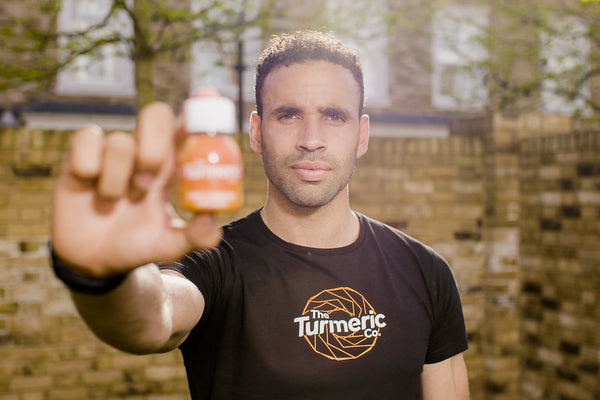
The Hal Robson-Kanu Guide To Fitness & Nutrition
Gain exclusive insight into habits that will make every day a healthy and fulfilling one.