


As we get older, keeping a sharp memory becomes one of the things we care about most, so it's no surprise that curcumin has caught the attention of brain researchers.
Curcumin and brain health is a young research area, with small trials and mixed results. In an 18-month UCLA trial of 40 adults aged 51 to 84, a curcumin supplement improved memory and attention compared with a placebo. Larger reviews find possible gains in working memory but no overall effect on thinking.
Key takeaways
- A handful of placebo-controlled trials in healthy older adults have found improvements in memory, attention, and working memory with curcumin supplements.
- Reviews that pool the trials find the clearest signal for working memory, rather than for thinking skills as a whole.
- The trials used specially formulated curcumin designed to be absorbed, and their results don't carry straight across to turmeric in food or drink.
- The NHS says there isn't enough evidence that curcumin helps people with dementia, and advises speaking to a doctor before trying it.
- What's good for your heart is good for your brain, which is where the strongest evidence for protecting memory lies.
What does the research say about curcumin and brain health?
That curcumin may support some aspects of memory in healthy older adults, and the evidence is still developing.
Researchers are interested in curcumin because of its anti-inflammatory and antioxidant properties. In the UCLA trial, people taking curcumin twice a day for 18 months did better on verbal and visual memory tests and on attention than those on a placebo. The study also used brain scans to look for changes linked to Alzheimer's disease, and those findings were less clear-cut.
Two trials from Swinburne University in Melbourne point the same way. In a 2015 trial of 60 healthy adults aged 60 to 85, attention and working memory were better an hour after a single dose, and working memory and mood were better after four weeks. A 12-week follow-up trial with 80 adults aged 50 to 80 found better working memory and lower fatigue. Its authors declared funding from the supplement industry, and the curcumin group also had higher blood glucose.
Working memory is defined as the short-term mental workspace you use to hold and handle information, such as keeping a phone number in your head while you dial it. It tends to decline with age, which is why it's a common focus of these trials.
| Trial | Who took part | What improved with curcumin |
|---|---|---|
| UCLA, 18 months | 40 adults aged 51 to 84 | Memory and attention |
| Swinburne, 4 weeks | 60 adults aged 60 to 85 | Attention, working memory, and mood |
| Swinburne, 12 weeks | 80 adults aged 50 to 80 | Working memory, with less fatigue |
| Review of 10 trials, 2025 | 531 people | Working memory and processing speed |
What do the larger reviews show?
A clearer picture for working memory than for thinking as a whole.
A 2025 review of 10 human trials with 531 people found no effect on overall thinking skills, but improvements in working memory and in processing speed, how quickly you take in and respond to information. An earlier review of eight trials with 389 people found much the same for working memory, again with no overall effect.
Not every trial has found a benefit. In a 12-month Australian trial of 96 older adults, the curcumin and placebo groups differed on only one measure, where thinking scores dropped in the placebo group at six months but not in the curcumin group. On every other test, there was no difference. Both reviews also found side effects, mostly to do with the stomach, were more common with curcumin than with a placebo.
Can curcumin help with dementia?
There isn't enough evidence to say it does.
A 24-week trial in 36 people with Alzheimer's disease found no difference between curcumin and a placebo, and levels of curcumin in the blood were low. The NHS page on dementia treatment names curcumin among the complementary remedies some people use, and says there's not enough evidence to say whether such remedies are effective.
The NHS also advises consulting a doctor before taking any such product or supplement, because some remedies interact with prescribed medicines, and they should never be taken as a substitute. If you or someone you care for has dementia, speak to your GP or pharmacist before adding curcumin.
Why are the results so mixed?
Partly because curcumin is hard for the body to absorb.
A review of curcumin's bioavailability found that very little reaches the bloodstream, because it's poorly absorbed and quickly cleared. That's why the trials with positive results used formulations designed to be absorbed better, and why trials differ so much in what they gave people. The studies were also small and short, and they measured different things, which makes them hard to compare. Our guide to curcumin absorption explains the absorption problem in more detail.
What does the NHS recommend for brain health?
Looking after your heart, because what's good for your heart is good for your brain.
The NHS advice on preventing dementia says research has found that around 4 in 10 cases could be prevented by changing the risk factors we're able to change. It recommends:
- eating a balanced diet and keeping to a healthy weight
- at least 150 minutes of moderate activity a week, plus strengthening exercises twice a week
- no more than 14 units of alcohol a week
- stopping smoking
- keeping your blood pressure in check, and treating hearing loss and depression
If you're aged 40 to 74, the free NHS Health Check every five years looks at several of these risks at once.
Mood is a related question, and Amy's guide on whether turmeric can boost your mood looks at that research. If stress and sleep are on your mind, our guide to ashwagandha for stress and sleep covers that evidence.
Is a turmeric shot the same as a curcumin supplement?
No. The trials used concentrated curcumin products, and a shot is a juiced food.
A juiced shot carries far less curcuminoid than an extract capsule, and it hasn't been tested for memory or thinking. Direct evidence on drinks like ours is limited, so if you take prescription medicines, speak to your pharmacist or GP before taking a shot regularly.
Which shot fits a daily routine?
The one with the most turmeric, taken every morning as part of a heart-healthy day.
Raw Turmeric Original has raw turmeric root at 30%, more than any other blend in our range, cold-crushed with whole watermelon, pineapple, and lemon, plus magnesium and vitamin C. It carries our trade-secret BioMax Uptake Blend®, which includes black pepper, at a 0.1% inclusion.
Independent researchers at Nottingham Trent University gave it to professional footballers in the first clinical trial of our blends, which found lower inflammation and less muscle soreness after matches. None of our trials has looked at memory, and a trial of Raw Turmeric Original in healthy older adults is under way. We're clearly not a neutral party.
The takeaway
Curcumin and brain health is a promising area, with small trials in healthy older adults finding better memory, attention, and working memory, and reviews pointing most clearly to working memory. The evidence is still developing, and the NHS says it isn't enough to recommend curcumin for dementia. The surest way to protect your memory is the heart-healthy routine the NHS recommends.
A Raw Turmeric Original with breakfast is an easy daily habit to build into that routine.
Frequently asked questions
Does turmeric improve memory?
Some small trials of curcumin supplements in healthy older adults have found better memory and working memory than with a placebo. These used specially formulated curcumin, and the results are mixed across all the trials.
Can curcumin prevent dementia?
There's no evidence that it does. The NHS says there isn't enough evidence that curcumin helps people with dementia, and a trial in people with Alzheimer's disease found no difference from placebo.
How long did the curcumin brain trials last?
Between four weeks and 18 months. The longest, the UCLA trial, found its memory improvements over 18 months.
Is curcumin safe to take for brain health?
It's generally well tolerated, though the reviews found more stomach side effects than with a placebo. If you take prescription medicines or have dementia, speak to your GP or pharmacist first.
Does turmeric help with brain fog?
No trial has tested turmeric for brain fog. A Swinburne trial found less fatigue with curcumin, but brain fog has many causes, so speak to your GP if it lasts.
What's the best thing I can do for my brain health?
Look after your heart. The NHS recommends a balanced diet, regular activity, keeping alcohol within 14 units a week, not smoking, and checking your blood pressure.

Raw Turmeric Original Shot Box
Our Original Turmeric Shot packs a real punch thanks to a whopping 35g of fresh raw turmeric root used to make each shot.
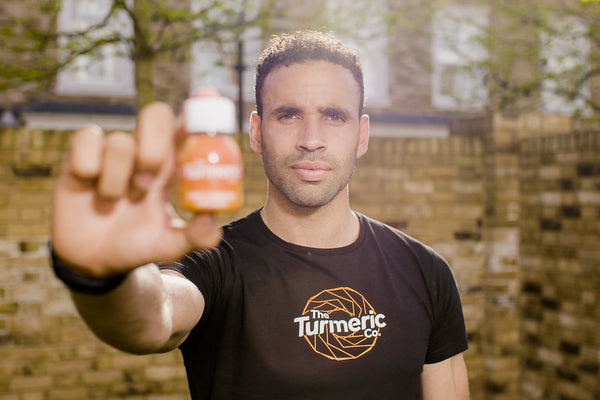
The Hal Robson-Kanu Guide To Fitness & Nutrition
Gain exclusive insight into habits that will make every day a healthy and fulfilling one.