


Does turmeric relieve pain, or is that the bit everyone repeats without checking? This is the general answer, drawn from the pooled trials rather than from the packaging, including the part where the evidence runs out.
The short-term evidence is genuinely strong. A systematic review of 69 trials covering 20 supplements in the British Journal of Sports Medicine placed curcumin and Curcuma longa extract among only seven with large, clinically important effects on osteoarthritis pain in the short term.
Key takeaways
- Short-term pain relief has large effect sizes in the pooled trials, which is unusual in this field.
- The same review found no supplement with clinically important effects on pain beyond the medium term.
- Across 29 arthritis trials, doses ran from 120mg to 1,500mg over 4 to 36 weeks.
- The overall quality of evidence is rated low, and the honest reading is promising rather than settled.
- Turmeric sits alongside exercise, weight management, and prescribed treatment, never instead of them.
So does turmeric relieve pain, according to the trials?
Yes, in the short term, and the effect size is large enough to be worth paying attention to.
That British Journal of Sports Medicine review is the most useful single piece of evidence here, because it did not set out to test turmeric. It compared 20 different supplements for osteoarthritis across 69 randomised trials, which means curcumin was competing rather than being showcased. Seven came out with large effects, defined as an effect size above 0.80, and clinically important short-term pain reduction. Curcumin and Curcuma longa extract were two of them, alongside collagen hydrolysate and Boswellia serrata.
For comparison, glucosamine and chondroitin, the two supplements most people have actually heard of, were either ineffective or showed effects too small to matter clinically. That is a meaningful result: the well-known ones underperformed, and turmeric did not.
Backing that up, a meta-analysis of 29 randomised trials in 2,396 people in Frontiers in Immunology, covering five different types of arthritis, found curcumin and Curcuma longa extract improved both pain and inflammation, with a good safety record across every study. Doses ran from 120mg to 1,500mg, for between 4 and 36 weeks.
Where does the evidence stop?
At the medium term, and this is the part most articles leave out.
The same 69-trial review that found large short-term effects also looked further out, and found no supplement at all with clinically important effects on pain at long-term follow-up. Only two, green-lipped mussel extract and undenatured type II collagen, held clinically important effects even at medium term. Curcumin was not among them.
There are two honest ways to read that. One is that the benefit fades. The other is that long-term trials are rare, expensive, and drop out, so the absence of evidence is partly an absence of studies. Both are probably true. What we can say is that if you are expecting a supplement to keep working indefinitely on its own, the trial record does not currently support that expectation for anything in this category.
The reviewers also rated the overall quality of evidence as very low, driven by small trials and inconsistent methods. Large effect, low certainty. That combination is worth holding in mind together rather than picking whichever half suits.
| What the pooled trials show | Confidence |
|---|---|
| Large short-term reduction in osteoarthritis pain | Reasonable, across 69 trials of 20 supplements |
| Improved pain and inflammation across five arthritis types | Reasonable, across 29 trials in 2,396 people |
| Good safety record at 120mg to 1,500mg | Consistent across studies |
What kind of pain has actually been studied?
Almost all of it is joint pain, and mostly osteoarthritis of the knee.
This matters, because "turmeric relieves pain" gets applied to headaches, period pain, back pain, and anything else that hurts. The trial base does not stretch that far. It is concentrated in osteoarthritis, with some work in rheumatoid arthritis and other inflammatory joint conditions, which makes sense given the mechanism is anti-inflammatory rather than analgesic.
Turmeric is not a painkiller in the way paracetamol is. It does not block pain signalling. What it appears to do is reduce inflammatory activity, which reduces the pain that inflammation is producing. That distinction explains both why it takes weeks rather than minutes, and why it does better in inflammatory joint pain than in pain with another cause.
If your interest is a specific joint, we have gone deeper elsewhere: turmeric for arthritis, turmeric for knee pain, and turmeric for back pain each cover their own evidence.
What does UK guidance say should come first?
Exercise and weight management, with medication where it is needed.
NICE guideline NG226 on osteoarthritis is clear that therapeutic exercise is the core treatment, alongside weight management where appropriate, and that these come before or alongside anything else. The NHS guidance on osteoarthritis says the same in plainer language, and Arthritis UK is the charity to turn to for living with it day to day.
Turmeric belongs after those, not instead of them. Anyone whose pain is new, severe, worsening, or accompanied by swelling, heat, or fever should see a GP rather than reach for a supplement. If you take prescription medication, particularly anticoagulants or glucose-lowering medicines, speak to your pharmacist or GP before making turmeric a daily habit.
How much, and for how long?
The trials that worked mostly ran for weeks, at amounts you have to be deliberate about reaching.
Across the 29-trial analysis, doses spanned 120mg to 1,500mg of curcumin or extract, over 4 to 36 weeks. Almost none of those trials found anything at a fortnight. That is the practical lesson: this is a habit with a runway, and eight to twelve weeks is a fair minimum before deciding whether it is doing anything for you.
Absorption is the other half of the problem, since curcumin on its own is poorly absorbed. That is a subject in itself, and our guide to turmeric bioavailability covers what actually helps.
The takeaway
Does turmeric relieve pain? On the pooled evidence, yes, in the short term, for inflammatory joint pain, with an effect size that beat most of the supplements it was compared against. Beyond a few months nothing in this category has demonstrated sustained benefit, and the certainty behind all of it is low. Promising, real, and unfinished.
The practical version is a daily habit you keep up for long enough to judge. Raw Turmeric & Ginger is our mobility blend, with ginger root and turmeric root at 15% each in a cold-crushed watermelon base, and it is the one we would put alongside the exercise that is doing most of the work.
Frequently asked questions
How long does turmeric take to work for pain?
Weeks, not hours. The trials ran from 4 to 36 weeks and the benefits emerged over that span. Give it eight to twelve weeks before judging, and keep taking it daily rather than only on bad days.
Is turmeric as good as ibuprofen for pain?
They work differently, and comparing them properly needs its own answer. Turmeric reduces inflammatory activity over weeks; anti-inflammatory medicines act far faster. Never stop or replace prescribed medication without speaking to your GP.
Does turmeric help with back pain or headaches?
The trial evidence is overwhelmingly in joint pain, particularly osteoarthritis of the knee. Extending it to other kinds of pain is an assumption rather than a finding, and back pain in particular has its own causes.
How much turmeric do I need for pain relief?
Trials used 120mg to 1,500mg of curcumin or standardised extract a day. Getting there from food alone is difficult, which is why absorption and format matter as much as the amount on a label.
Is turmeric safe to take every day for pain?
The pooled trials reported a good safety record across doses and durations. Check with your pharmacist or GP if you take anticoagulants, glucose-lowering medicines, or have gallstones, and before any planned surgery.
Should I take turmeric instead of my arthritis medication?
No. NICE guidance puts exercise and weight management at the core of osteoarthritis care, with medication where needed. Turmeric sits alongside all of that, and any change to prescribed treatment is your GP's decision.

Raw Turmeric & Ginger Shot Box
Combining two ‘super roots’ in turmeric and ginger makes this a naturally potent shot combination.
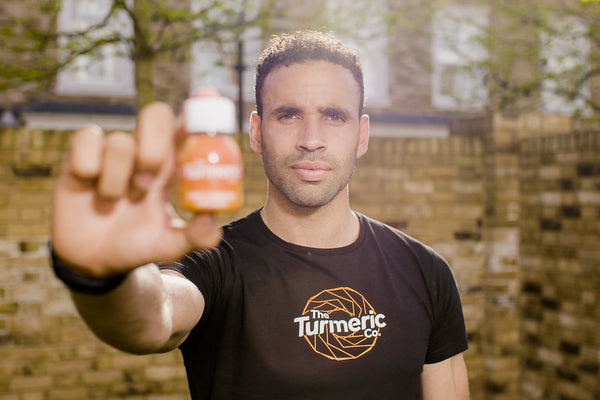
The Hal Robson-Kanu Guide To Fitness & Nutrition
Gain exclusive insight into habits that will make every day a healthy and fulfilling one.