


Turmeric and blood pressure is a question with a genuinely mixed answer, and the mixed answer is more useful than the confident one, so this is what the pooled trials found and how much of it matters.
The most recent pooling is cautiously positive. A GRADE-assessed meta-analysis of 35 randomised controlled trials in Clinical Nutrition ESPEN found curcumin and turmeric supplementation lowered systolic blood pressure by about 2 mmHg, and improved flow-mediated dilation, a measure of how well blood vessels widen.
Key takeaways
- Two large recent reviews reach different conclusions, and the honest summary is a small effect rather than a clear one.
- The most recent, covering 35 trials, found systolic pressure about 2 mmHg lower and blood vessel function measurably better.
- An earlier review of 17 trials found no overall effect, but did find one in trials running 12 weeks or more.
- 2 mmHg is real but modest. It is not a substitute for medication, weight, salt, alcohol, or exercise.
- If you take blood pressure medicine, speak to your pharmacist or GP before adding anything daily.
What does the evidence on turmeric and blood pressure actually say?
Two big reviews, two different answers, and the difference between them is the interesting part.
Let's take them in order. The 35-trial review above found significant improvements in systolic pressure, at a weighted mean difference of 2.02 mmHg, and in diastolic pressure at 0.82 mmHg. It also found lower VCAM-1, a marker of blood vessel inflammation, and a two percentage point improvement in flow-mediated dilation. Not every measure moved: pulse-wave velocity, a stiffness measure, did not.
Against that, a dose-response meta-analysis of 17 trials in 1,377 people in Nutrition, Metabolism and Cardiovascular Diseases found no significant overall effect on either number. Its subgroup findings are where it gets interesting. In trials running 12 weeks or longer, diastolic pressure did fall. And in trials conducted in women, both numbers fell significantly.
So what should you take from a disagreement like that? Mostly that the effect is small enough to appear or disappear depending on which trials you pool, how long they ran, and who was in them. A large, obvious effect does not behave that way. A small, real one does.
| What was measured | 35-trial review | 17-trial review |
|---|---|---|
| Systolic pressure | Down about 2 mmHg | No significant change overall |
| Diastolic pressure | Down about 0.8 mmHg | Down in trials of 12 weeks or more |
| Blood vessel widening | Improved by 2 percentage points | Not assessed |
| Vessel inflammation marker | Lower | Not assessed |
How much is 2 mmHg worth?
Enough to be worth having, and nowhere near enough to replace anything.
Scale matters here more than significance. NHS guidance defines high blood pressure as a reading of 140/90 or above when taken by a healthcare professional, or 135/85 or above when taken at home. If your reading sits well into that territory, a couple of millimetres of mercury is not the answer, and the NHS advice on high blood pressure sets out what actually moves the number: weight, salt, exercise, alcohol, and where needed, medication.
Where a small effect is worth something is at population scale, and as one of several small things stacked together. Turmeric belongs in that second category. It is a reasonable addition to a diet already doing the heavy lifting, and it is not a treatment.
Why might turmeric affect blood pressure at all?
Through the lining of the blood vessels, which is the part the flow-mediated dilation result is pointing at.
Flow-mediated dilation measures how well an artery widens when blood flow increases. It is a proxy for endothelial function, the health of the single cell layer lining your blood vessels, and it tends to track with cardiovascular risk. The 35-trial review found a two percentage point improvement, alongside a drop in VCAM-1, a molecule the vessel lining produces when it is inflamed.
That is a coherent story rather than a proven chain: curcumin's best-replicated effect is on inflammatory markers, the vessel lining is sensitive to inflammation, and vessel lining function influences pressure. Coherent is not the same as demonstrated, and the modest size of the blood pressure findings is roughly what you would expect from a mechanism working at one remove.
Does beetroot do more for blood pressure than turmeric?
On the current evidence, yes, and it is worth saying so plainly.
Dietary nitrate has a stronger and more consistent blood pressure literature than curcumin, and much of the best work is British. A randomised trial in 68 patients with high blood pressure, published in Hypertension and funded by the British Heart Foundation, found daily dietary nitrate lowered clinic blood pressure by 7.7/2.4 mmHg. A meta-analysis of 16 trials led from Newcastle University found systolic pressure about 4.4 mmHg lower, with more nitrate producing more effect.
Those are larger numbers than anything in the curcumin literature, and we would rather point you at them than pretend otherwise. It is also why Raw Turmeric & Beetroot exists: beetroot at 19% alongside turmeric root at 10%, pomegranate, and ginger root, in a cold-crushed watermelon base with vitamin C and thiamine.
Who should check with a pharmacist or GP first?
Anyone on blood pressure medication, and anyone already monitoring readings at home.
That is the important line in an article like this. If you are being treated for high blood pressure, the decision about what else to take daily belongs with your healthcare professional, who knows your readings and your prescriptions. The same applies if you take anticoagulants, since turmeric may affect clotting when taken in large amounts, or glucose-lowering medicines. The Welsh Medicines Advice Service guidance on turmeric interactions is the NHS resource covering this, and it notes that most reported interactions relate to medicinal doses of turmeric or concentrated curcumin extracts rather than to turmeric in food and drink.
Our shots are cold-crushed whole-food blends carrying far less curcuminoid than an extract capsule, which is the distinction that matters most here. Direct evidence on beverages specifically is limited, and much of the interaction work is laboratory or animal research that may not translate. Speak to your pharmacist or GP before making anything a daily fixture.
The takeaway
Turmeric and blood pressure is a small effect that shows up in some poolings and not others, with the most recent and largest review putting it at roughly 2 mmHg systolic alongside better blood vessel function. That is worth having as part of a wider habit, and it is not a treatment for hypertension. Beetroot's nitrate evidence is stronger, and the best of it is British.
If the cardiovascular side is what you are after, Raw Turmeric & Beetroot puts both roots in one cold-crushed blend, which is the simplest way to make either of them a habit rather than a resolution.
Frequently asked questions
Does turmeric lower blood pressure?
Slightly, on the best current evidence, and not in every analysis. A review of 35 trials found systolic pressure about 2 mmHg lower; a review of 17 trials found no overall effect. Treat it as a small contribution, not a treatment.
How long does turmeric take to affect blood pressure?
The clearest signal came from trials running 12 weeks or longer, where diastolic pressure fell even in the analysis that found no overall effect. Give any dietary change at least three months before judging it.
Can I take turmeric with blood pressure tablets?
Ask your pharmacist or GP first. They know your readings and your prescriptions, and reported interactions mostly concern medicinal doses of turmeric or concentrated extracts rather than turmeric in food and drink.
Is beetroot better than turmeric for blood pressure?
On the numbers, yes. British trials on dietary nitrate report reductions of roughly 4 to 8 mmHg systolic, which is several times what the curcumin poolings show. Both can sit in the same blend, which is the practical answer.
What actually lowers blood pressure most?
Weight, salt intake, physical activity, alcohol, and where needed, prescribed medication. NHS guidance covers all of it. Anything you drink sits alongside those rather than instead of them.
What counts as high blood pressure in the UK?
A reading of 140/90 or above when taken by a healthcare professional, or 135/85 or above when taken at home. If you are near or above either, that is a conversation with your GP rather than a shopping decision.

Raw Turmeric & Beetroot Shot Box
This Turmeric Shot fused with Beetroot is a real powerhouse of a shot.
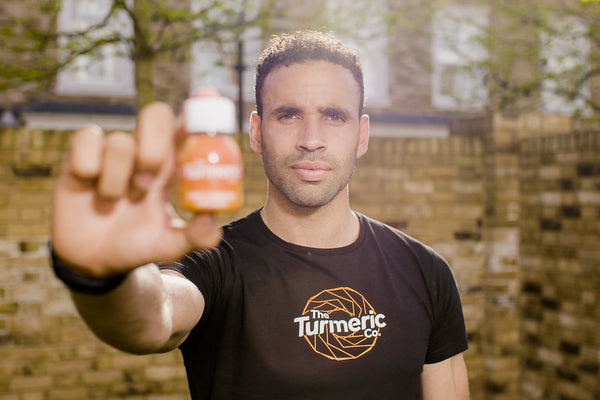
The Hal Robson-Kanu Guide To Fitness & Nutrition
Gain exclusive insight into habits that will make every day a healthy and fulfilling one.