


Batch making turmeric shots is the difference between a habit and a good intention, because almost nobody grates a root at seven in the morning twice, let alone twenty times.
Making a week's worth in one go takes about twenty minutes and turns a daily job into a weekly one. That is the entire argument for doing it. A batch of seven 60ml shots needs roughly 150g of fresh turmeric root, a similar weight of fresh ginger, and the juice of two or three lemons.
Key takeaways
- A week of shots takes about twenty minutes once, instead of five minutes every morning.
- Roughly 150g each of turmeric and ginger root makes about seven 60ml servings.
- Wear gloves. Fresh turmeric stains hands, boards, and worktops immediately and stubbornly.
- Store in small individual containers rather than one big jar, so you only open one at a time.
- Government guidance on chilling food safely applies here exactly as it would to any fresh juice.
What do you need for batch making turmeric shots?
A juicer or a blender with a straining step, small containers, and gloves. Everything else is optional.
The kit question is the first fork in the road. A juicer gives you a clean liquid and does the separating for you, which is faster but means buying and washing a juicer. A blender plus a nut milk bag, a fine sieve, or a clean tea towel does the same job for less money and more washing up. Both work. Neither is worth agonising over.
The containers matter more than people expect. Small individual bottles or jars, one per serving, keep six days of shots sealed while you drink the seventh. A single large jar gets opened seven times, which is seven chances for it to oxidise and pick up whatever is in your fridge.
And gloves are not optional advice dressed up as a tip. Fresh turmeric root stains skin bright yellow for days, and it does the same to wooden boards and porous worktops.
What ratio actually works?
Equal weights of turmeric and ginger, sharp citrus, and something to carry it. Adjust the heat, not the roots.
| Ingredient | For about 7 shots | What it does |
|---|---|---|
| Fresh turmeric root | 150g | The point of the exercise |
| Fresh ginger root | 150g | Heat and its own gingerol content |
| Lemons | 2 to 3, juiced | Sharpness, and it cuts the earthiness |
| Orange or pineapple | 200ml juiced | Carries the flavour, adds sweetness |
| Black pepper | A few good grinds | Piperine, though see the caveat below |
| Olive or rapeseed oil | 1 teaspoon | Curcumin is fat soluble |
The pepper deserves a note, because it is routinely oversold. Piperine slows the process that clears curcumin from your body, which is why it appears in turmeric products at all. The often-quoted absorption figures come from studies pairing gram-scale curcumin with 20mg of isolated piperine, and a few grinds over a jug is not that. Add it because it belongs in the flavour, and because it plausibly helps a little. Our guide to curcumin absorption covers what the evidence actually supports.
Ground turmeric powder is a fine thing in cooking and it is not a substitute here. Powder earns its place on flavour, and it will not give you a meaningful daily amount in a shot.
What order should you work in?
Juice the hard things first, the soft things last, and strain once at the end.
There is a practical sequence that saves a rinse. Start with the turmeric and ginger roots, since they are dense and fibrous and will leave the machine coated. Follow with the citrus and softer fruit, which pushes the last of the root pulp through and rinses the mechanism as it goes. Whisk in the oil and pepper at the end, in the jug, rather than trying to juice them.
Then decant straight into your individual containers while it is still cold, seal them, and get them into the fridge. Government guidance on chilling food safely is the reference to follow, and the principle is the boring one: get it cold quickly and keep it cold.
Do not throw the pulp away. There is a surprising amount left in it, and what to do with leftover turmeric pulp covers where it can go.
How long will a batch keep?
Days rather than a fortnight, and your nose is not a reliable test.
Fresh juice with no preservatives and no heat treatment has a short life, which is the honest trade-off for making it yourself. Small sealed containers, filled to the top to reduce the air in them, kept properly chilled, and treated as a few days' supply rather than a monthly project, is the sensible approach. Freezing in portions extends that considerably, and both storage and freezing deserve their own answers rather than a line here.
The wider point is that a homemade batch is a genuinely good thing that decays from the moment you make it, while a commercially produced shot is made under food safety controls and cold chain that a kitchen cannot replicate. Neither fact cancels the other.
Is it worth the effort?
If you enjoy it, absolutely. If you are doing it purely to save money, be honest with yourself about week three.
That is the part worth saying plainly. Batch making works brilliantly for people who like the process, and it collapses for everyone else, usually somewhere around the second Sunday when the kitchen needs cleaning and the roots have gone soft in the drawer. The trials behind turmeric's benefits ran for weeks and months, so the format that wins is whichever one you are still doing in March.
We make the version for the weeks when you are not going to do it. Raw Turmeric & Ginger puts ginger root and turmeric root at 15% each in a cold-crushed watermelon base with magnesium and vitamin C, and Raw Turmeric Original carries the most turmeric in our range at 30%. Both include BioMax Uptake Blend®, our trade-secret black pepper mix, at a 0.1% inclusion.
The takeaway
Batch making turmeric shots is straightforward: equal weights of turmeric and ginger, sharp citrus to cut it, a carrier juice, a teaspoon of oil, gloves on, hard ingredients first, and straight into small sealed containers in a cold fridge. Twenty minutes buys you a week.
Do it while you enjoy it, and keep Raw Turmeric Original in the fridge for the weeks you do not, because the only version that works is the one that survives a bad Monday.
Frequently asked questions
How much turmeric root do I need for a week of shots?
Around 150g of fresh turmeric and 150g of fresh ginger makes roughly seven 60ml servings, once you add citrus and a carrier juice. Buy a little more than you think, since roots vary and some will be past their best.
Do I need a juicer to batch make turmeric shots?
No. A blender plus a nut milk bag, a fine sieve, or a clean tea towel works. A juicer is faster and cleaner; a blender is cheaper and messier. The result is close enough that the choice is about washing up.
How do I stop turmeric staining everything?
Wear gloves, use a plastic or glass board rather than wood, and rinse equipment straight away rather than letting it sit. Bicarbonate of soda paste helps on worktops. Assume anything porous will stain permanently.
Should I add black pepper to homemade turmeric shots?
Add it for flavour and because it plausibly helps a little. Do not expect the dramatic absorption figures from the research, which came from gram-scale curcumin paired with 20mg of isolated piperine rather than a few grinds over a jug.
Can I use turmeric powder instead of fresh root?
For flavour, yes. For a meaningful daily amount of turmeric, no. Powder is a cooking ingredient, and a shot made with it is a different and much weaker proposition than one made from fresh root.
How many shots should I make at once?
A week is the practical maximum for fresh juice kept in the fridge. Beyond that you are into freezing, which changes both the method and how long it keeps, and is worth planning for separately.

Raw Turmeric Original Shot Box
Our Original Turmeric Shot packs a real punch thanks to a whopping 35g of fresh raw turmeric root used to make each shot.
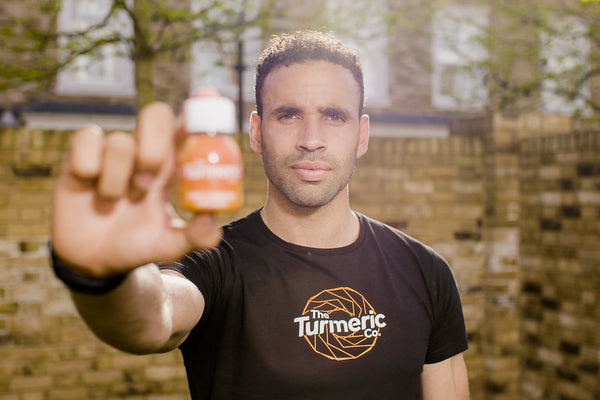
The Hal Robson-Kanu Guide To Fitness & Nutrition
Gain exclusive insight into habits that will make every day a healthy and fulfilling one.