


Capsule packs love a big percentage, and 95% curcuminoids sounds like the last word on strength until you ask what it's 95% of.
Curcuminoid extract explained simply: it's turmeric refined down to its yellow compounds, and the percentage on the label is how much of the extract's weight those compounds make up. A 95% figure describes purity, and says nothing about how much reaches your blood, as a small crossover study of two extracts showed.
Key takeaways
- Curcuminoids are a family of three related compounds: curcumin, demethoxycurcumin, and bisdemethoxycurcumin.
- A 95% figure is a share of the extract's weight, so it measures purity rather than what happens in your body.
- To work out a dose, you also need the weight of extract in each capsule and the number of capsules in a serving.
- In small studies, a lower-percentage formulated extract kept pace with a 95% one at a tenth of the dose, and whole turmeric beat curcumin powder in the same meal.
- A review of 125 turmeric products found 34% didn't disclose their curcuminoid content at all.
What is a curcuminoid extract?
Turmeric root refined until curcuminoids make up most of what's left.
Curcuminoids are defined as the group of yellow compounds in turmeric root, made up of curcumin, demethoxycurcumin, and bisdemethoxycurcumin. An extract concentrates them. An analysis of 28 spice products found pure turmeric powder averaged 3.14% curcumin by weight, which gives a sense of how far a 95% extract has travelled from the kitchen jar. The powder figure counts curcumin alone, so it's not quite like for like.
You'll often see "curcumin" and "curcuminoids" used as if they meant the same thing. Curcumin is the best known of the three, and a label saying 95% curcuminoids gives you the total without telling you how it splits between them.
What does 95% actually mean on a label?
It's the share of the extract's weight that's curcuminoids, and that's all it tells you.
If a capsule holds 500mg of a 95% extract, it carries about 475mg of curcuminoids. If the pack only shouts "95%" and doesn't give the extract weight, you can't do that sum. Check how many capsules make up a serving as well.
These are worked examples, using round numbers rather than any particular product:
| On the label | What it tells you |
|---|---|
| 95% curcuminoids | 95% of the extract's weight is the three curcuminoids combined |
| 500mg of a 95% extract | About 475mg of curcuminoids per capsule |
| 500mg of ground turmeric | About 16mg of curcumin per capsule, taking powder at around 3% |
| Black pepper or piperine | An added ingredient included to help absorption |
Is a curcuminoid extract explained by its percentage?
Only partly. The percentage gives you purity, and how much reaches your blood depends largely on other things.
Curcuminoids barely dissolve in water, and the body deals with them fast. A review of curcumin's low blood levels puts it down to poor absorption, rapid metabolism, and rapid elimination. In one study of healthy volunteers, only one of 12 people had detectable free curcumin after a dose of 10g or 12g, though its breakdown products turned up in all of them. A purer starting material doesn't get around any of that.
Formulation can move the number. In the crossover study above, 14 people took either one capsule of a water-dispersible 60% extract or three capsules of a 95% extract, and peak blood levels of free curcumin and total curcuminoids were similar, despite a tenth of the curcuminoid dose. All the authors are listed at commercial companies rather than universities. A lecithin formulation delivered around 29 times more total curcuminoids than an unformulated mixture, in a trial with industry involvement too.
Whole turmeric tells a similar story. In a crossover study of healthy men, meals with 400mg of curcumin from grated fresh root or ground turmeric produced higher blood curcuminoids than the same amount from curcumin powder, all served with mashed potato and cream. The researchers suggest other compounds in turmeric, or the structure of the root itself, may play a part.
Matching that 400mg with the spice would take around 13g of ground turmeric at 3%, so the finding is no reason to spoon powder into your day. Powder is for flavour. Our guide to curcumin absorption goes further into what helps.
Why is the curcuminoid figure sometimes missing?
Because plenty of products simply don't print it.
Researchers at Hannover Medical School reviewed 125 turmeric preparations sold across the UK, USA, India, Australia, and Germany, and 34% didn't disclose their curcuminoid content. They also reported labelling inconsistencies, pointed out that supplements sold under food law don't go through the controls applied to medicines, and called for more transparent labelling.
So look for curcuminoids in milligrams per serving, alongside the percentage. That's the number you'd need to compare a product with research, and even then it's a rough match, as our guide to curcumin dose in studies explains.
Is a concentrated extract different from turmeric in food?
Yes, and it's the reason so much of the safety advice is aimed at it.
The concern around prescription medicines centres on medicinal doses of turmeric and concentrated curcumin extracts rather than the turmeric in your dinner. The evidence is limited, and much of it is lab and animal work that medicines advisers at NHS Wales say may not be clinically relevant in people. They do advise caution, particularly alongside anticoagulants and antiplatelets such as warfarin and clopidogrel.
The same service notes that oral turmeric is usually well tolerated, and that combining curcumin with piperine increases absorption, which may have safety implications. For scale, EFSA's acceptable daily intake for curcumin, set for its use as a food colouring, is 3mg per kilogram of body weight a day, or about 210mg for a 70kg adult.
If you take prescription medicines, speak to your GP or pharmacist before starting a concentrated extract, or before taking turmeric regularly in any form.
Where does a turmeric shot sit?
It's a different kind of product, so the 95% question doesn't really apply.
A shot is a juiced whole-food drink, and it carries far less curcuminoid than a concentrated extract capsule. Raw Turmeric Original lists raw turmeric root at 30%, the most in our range, in a cold-crushed, whole watermelon-based blend with pineapple and lemon, plus added magnesium and vitamin C. It also carries our trade-secret BioMax Uptake Blend®, which includes black pepper, at a 0.1% inclusion.
That 30% is root as a share of the whole blend, and our label gives no curcuminoid figure, so it can't be set against an extract's 95%. What it has instead is its own research. In the first clinical trial of our blends, independent researchers at Nottingham Trent University gave Raw Turmeric Original to 16 of 24 elite male footballers, with the other 8 as controls, and found lower CRP, a marker of inflammation, 64 hours after matches, plus less soreness. There was no placebo or blinding, and we're clearly not a neutral party.
The takeaway
A curcuminoid extract is turmeric concentrated down to three yellow compounds, and 95% tells you how pure that extract is. It can't give you the dose without the extract weight, and it can't tell you how much you'll absorb at all. Read the milligrams per serving and the formulation before the headline percentage, and check with your GP or pharmacist first if you take prescription medicines.
If what you're after is turmeric you'll actually take each morning, you can leave the label maths behind. A Raw Turmeric Original with breakfast is an easy daily habit to keep.
Frequently asked questions
What does 95% curcuminoids mean?
It means 95% of the extract's weight is curcuminoids, the three yellow compounds in turmeric. It's a purity figure, and it doesn't tell you the dose or how well the extract is absorbed.
Is curcuminoid extract the same as curcumin?
Not quite. Curcumin is one of three curcuminoids, alongside demethoxycurcumin and bisdemethoxycurcumin. A 95% figure is the total of all three.
Is a higher curcuminoid percentage better?
Not necessarily. In one small study, a 60% water-dispersible extract gave similar peak blood levels to a 95% extract at a tenth of the dose, though the authors worked in industry. The formulation matters as well as the purity.
How much curcuminoid is in a 500mg capsule?
At 95%, about 475mg, as long as the 500mg refers to the extract itself. Check the label for that, and for how many capsules make up a serving.
Why don't some labels show a curcuminoid figure?
One review of 125 turmeric products found 34% didn't disclose it, and its authors called for more transparent labelling. Without that figure, you can't work out how much you're getting.
Does a turmeric shot contain 95% curcuminoids?
No. A shot is a juiced whole-food drink with far less curcuminoid than an extract capsule. Raw Turmeric Original lists turmeric root at 30% of the blend, which is a different measure altogether.

Raw Turmeric Original Shot Box
Our Original Turmeric Shot packs a real punch thanks to a whopping 35g of fresh raw turmeric root used to make each shot.
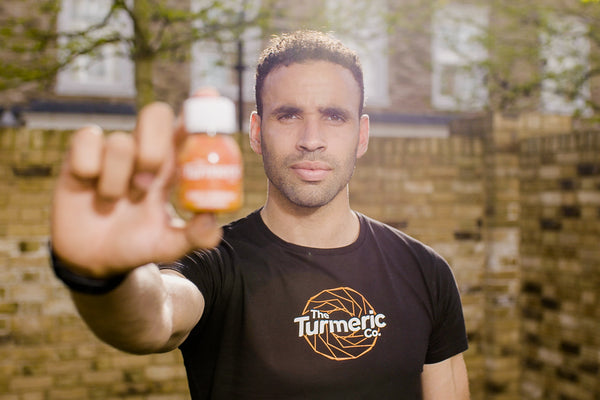
The Hal Robson-Kanu Guide To Fitness & Nutrition
Gain exclusive insight into habits that will make every day a healthy and fulfilling one.