


Post-workout nutrition has been oversold for years. Here's what the UK guidance actually says, and what you can stop worrying about.
Post-workout nutrition matters most when you're training again soon. UK guidance puts protein for active people at roughly 1.4 to 2.0g per kilo of body weight a day, spread across meals, with carbohydrate scaled to how much you're actually doing. For most people, a normal meal within a couple of hours covers it.
Key takeaways
- Daily totals beat timing. Hitting your protein and carbohydrate across the day matters far more than what you eat in the half hour after training.
- The tight anabolic window has not held up well. It matters when you're training twice in a day, and very little otherwise.
- Rehydrate to thirst rather than to a formula, and remember that sodium in a meal helps you hold onto what you drink.
- Supplements sit on top of food, never instead of it, and the ones worth taking are worth taking daily.
What is post-workout nutrition, and does it matter?
Post-workout nutrition is defined as the food and fluid you take in after exercise to restore energy, support muscle repair, and rehydrate. Whether it matters much depends almost entirely on how soon you're training again.
If you've got 24 hours before your next session, your daily totals will do the work and the exact timing barely registers. If you're training twice in a day, or racing again tomorrow, the picture changes and getting fuel in promptly becomes genuinely useful.
The British Dietetic Association's sport and exercise nutrition guidance puts it plainly: start refuelling with carbohydrate-rich foods and fluids as soon as you practically can, particularly when you're doing repeated training bouts in a short space of time.
How much protein and carbohydrate do you need?
More protein than a sedentary person, and carbohydrate scaled to your actual training volume rather than to how hard the session felt.
UK guidance sets protein for people training for strength or endurance at around 1.4 to 2.0g per kilo of body weight a day, against about 0.75g per kilo for someone not exercising. If you're specifically chasing muscle gain alongside resistance training, that lands nearer 1.6 to 1.7g per kilo. Spreading it evenly across your meals works better than saving it all for dinner.
Carbohydrate scales with the work. The British Nutrition Foundation is a useful reference on where protein actually comes from, and the NHS Eatwell Guide sets the proportions for everything else.
| Training pattern | Carbohydrate per kg of body weight, per day |
|---|---|
| Light, 1 to 2 hours, three to five times a week | 3 to 5g |
| Moderate to high, 2 to 3 hours daily, five to six times a week | 5 to 8g |
| Intense, 3 to 6 hours daily across one or two sessions | 8 to 10g |
Those are daily figures, not post-session figures, which is the point most people miss. A 75kg runner training an hour most days needs somewhere in the region of 375 to 600g of carbohydrate across the day, and no single recovery shake is going to move that number meaningfully.
Does the anabolic window really exist?
It exists, but it's much wider than the supplement industry spent two decades suggesting.
The old advice was to get protein in within 30 to 45 minutes or waste the session. The research has since moved towards total daily intake and even distribution mattering far more, with the post-session window stretching to several hours for most people.
Where prompt refuelling still earns its keep is the repeated-bout scenario: a double day, a tournament, a stage race, a morning swim followed by an evening run. There, getting carbohydrate in early genuinely changes how the second session goes.
For everyone else, a decent meal within a couple of hours is fine. If that meal happens to land soon after training, better still, though not because a window slammed shut.
What should you drink after training?
Enough to replace what you lost, spread over the following hours rather than downed in one go.
UK guidance suggests drinking to just stay ahead of thirst, which is a more sensible instruction than any fixed number of litres. Thirst is a decent guide for most sessions in a British climate.
Including some sodium helps you hold onto the fluid, which is one reason a normal meal with a bit of salt in it rehydrates you more effectively than plain water alone. Sports drinks are useful in long or very hot sessions, and largely unnecessary for an hour in the gym.
What's worth adding on top?
Very little, honestly, and the things that are worth it are worth taking every day rather than only after training.
Most of the post-workout aisle is solving a problem you don't have. Protein powder is a convenience, not a magic ingredient, and it counts towards the same daily total that food does - a cheese sandwich would do the same job!
Turmeric is one of the few with credible trial data behind it. Ten randomised controlled trials point to less soreness and lower muscle damage markers after hard exercise, which we go through properly in turmeric for muscle soreness.
Independent research on The Turmeric Co. blends found the same direction of travel, in professional footballers on two shots a day. We funded it and did not influence the findings.
The important detail is that curcumin makes up only around 3% of turmeric root and is poorly absorbed on its own, so it needs black pepper and a little fat to be worth taking at all.
If soreness rather than fuelling is your main problem, turmeric for muscle soreness goes into the DOMS research properly, and our older guide to recovery foods and drinks for DOMS has the snack-level detail.
The takeaway
Get your daily protein and carbohydrate roughly right, drink to thirst, and stop treating the half hour after training as a crisis. That covers most of what post-workout nutrition can do for you.
Then, if you want to add something, pick one with evidence behind it and take it every single day rather than only when you remember. Consistency is the whole game, and it's exactly where powders, jars, and good intentions tend to fall down.
Which is where a shot earns its keep over a tub or a jar. Raw Turmeric Original has the black pepper mix built in and nothing to weigh out, so the decision is made for you on the mornings you can't be bothered. The fresh fruit in it does a job too, carrying the nutrients rather than padding the bottle out the way concentrated apple or orange juice does. If you train hard enough that your joints notice, Raw Turmeric & Ginger is the one to reach for.
One a day, alongside real meals. If you're managing a health condition or on medication, check with your GP before adding supplements.
Frequently asked questions
What should I eat straight after a workout?
A normal meal containing protein and carbohydrate is fine for most people: eggs on toast, chicken and rice, a bowl of porridge with yoghurt and fruit. Aim for it within a couple of hours. Only if you're training again the same day does getting something in quickly become genuinely important.
How much protein do I need after training?
Focus on your daily total rather than a single post-session dose. UK guidance puts active people at roughly 1.4 to 2.0g of protein per kilo of body weight a day, spread evenly across meals, against about 0.75g per kilo for someone who isn't exercising. Landing 20 to 40g in a post-training meal fits neatly inside that.
Is the 30-minute anabolic window real?
Not in the strict form it was sold in. Total daily protein and even distribution across meals matter considerably more than hitting a narrow window. Prompt refuelling still matters when you're training twice in a day or competing on consecutive days, which is the scenario the original advice came from.
Do I need a protein shake after the gym?
No. A shake is a convenience, not a requirement, and it counts towards the same daily protein total that food does. If you find eating soon after training difficult, or you're travelling between sessions, a shake is a reasonable practical solution rather than a nutritionally superior one.
What should I drink after exercise?
Water is enough for most sessions, drunk steadily over the following hours rather than all at once. UK guidance suggests drinking to just stay ahead of thirst. Having a meal with some salt in it afterwards helps you retain the fluid, and sports drinks earn their place mainly in long, hot, or repeated sessions.
Does turmeric help with post-workout recovery?
The trial evidence supports a moderate effect on soreness and muscle damage markers, and our own footballer trial found lower inflammation markers at 64 hours after a match. It works as a daily habit rather than a post-session dose, and only in a form with absorption support, since curcumin is poorly absorbed on its own.

Raw Turmeric Original Shot Box
Our Original Turmeric Shot packs a real punch thanks to a whopping 35g of fresh raw turmeric root used to make each shot.
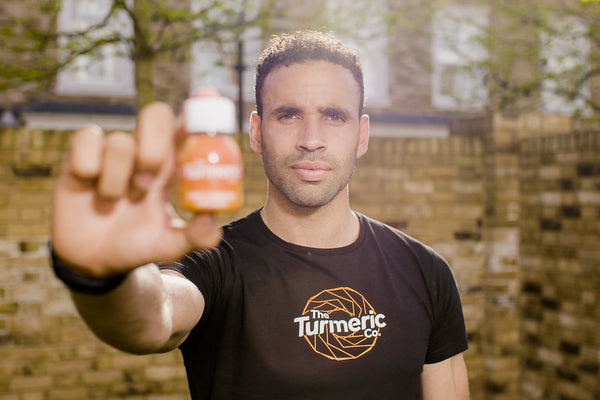
The Hal Robson-Kanu Guide To Fitness & Nutrition
Gain exclusive insight into habits that will make every day a healthy and fulfilling one.