


Curcumin and turmeric are often used as if they mean the same thing. They don't, and the difference changes how you choose and take it.
So what is curcumin? It's the most studied compound inside turmeric root, and it accounts for only about 3% of the root by weight. Turmeric is the whole root: curcumin plus a long list of other bioactive compounds, including turmerones and essential oils. Think of turmeric as the team, and curcumin as the star player.
If you've ever looked into turmeric supplements, you've almost certainly come across the word curcumin, sometimes used as if it means the same thing as turmeric. It doesn't, and understanding the difference matters, especially if you're trying to decide which form of turmeric is right for you. This guide explains what curcumin actually is, how it relates to the root, what else the plant contains, and why all of that should shape how you take it.
Key takeaways
- Curcumin is turmeric's most studied compound, and only a small fraction of the whole root.
- Turmeric also contains turmerones, essential oils and other compounds, not curcumin alone.
- Labels differ: "500mg turmeric" and "500mg curcumin" deliver very different amounts.
- Curcumin is poorly absorbed on its own, so black pepper and a little fat help whichever form you choose.
What is curcumin, exactly?
Curcumin is defined as the most abundant curcuminoid in turmeric, and it's the compound that gives the root its vivid yellow colour. Turmeric (Curcuma longa) is a golden root from the ginger family, used across South and Southeast Asia for thousands of years both as a cooking spice and in traditional Ayurvedic medicine. When researchers began looking at what makes it interesting from a health perspective, they found a family of compounds called curcuminoids. There are three main ones:
- Curcumin, the main curcuminoid and the most studied
- Demethoxycurcumin, a related but less concentrated compound
- Bisdemethoxycurcumin, present in the smallest amount of the three
A review of dietary curcumin in the journal Nutrients attributes most of turmeric's studied activity to the curcuminoids, and Arthritis UK notes that turmeric is believed to have anti-inflammatory properties. Curcumin is one of the most heavily researched plant compounds in the world, with thousands of published studies appearing in scientific databases. The evidence is still developing, so it's fairer to say curcumin may support these areas than to promise a result, and our guide to turmeric benefits and what the evidence shows goes through it claim by claim.

Here is the detail that matters most. Curcumin accounts for only around 3% of turmeric root, so a teaspoon of turmeric powder gives you a very small amount of it. That single fact is why the supplement industry has focused so heavily on isolating and concentrating the compound.
Why does the difference between turmeric and curcumin matter?
If you're comparing turmeric products, the labels can be confusing. Some state their turmeric content. Others state their curcumin content. Others say "standardised to 95% curcuminoids", which means the curcumin has been extracted and concentrated far beyond what occurs naturally in the root.
The numbers look very different depending on which measure is used:
| Format | Curcumin content | What's included |
|---|---|---|
| Fresh turmeric root | ~3% curcumin | Whole root: curcumin, turmerones, essential oils, fibre, natural fats |
| Turmeric powder (spice) | ~3 to 5% curcumin | Dried and ground root, some natural compounds lost in processing |
| Turmeric extract (supplement) | Up to 95% curcuminoids | Concentrated curcumin, often with piperine or other absorption aids added |
| Raw turmeric shot | Whole-root level, not concentrated | Whole root in liquid form, retains oils and compounds, often with black pepper built in |
One figure there can look odd at first: dried powder shows a slightly higher percentage than fresh root. That's a concentration effect, not extra curcumin. Fresh root is mostly water, and drying removes it, so the curcumin that remains makes up a larger share of each gram.
A supplement labelled "500mg turmeric" and one labelled "500mg curcumin" are delivering very different things. The first gives you the whole root equivalent, including roughly 15mg of curcumin. The second gives you 500mg of the isolated compound. They're not interchangeable, and which one suits you comes down to whether you want the isolated compound or the whole root behind it.
What else is in turmeric besides curcumin?
Beyond curcumin, turmeric contains many other bioactive compounds. Among the most studied are:
- Turmerones, aromatic compounds that make up a significant part of turmeric's essential oil fraction. Early research suggests they may support curcumin absorption and have their own biological activity.
- Essential oils, natural oils in the root that may help the body take up curcumin more effectively, in a similar way to how fat assists absorption.
- Polysaccharides, complex carbohydrates being studied for their potential effects on gut health.
- Vitamins and minerals, including manganese, iron and small amounts of vitamin C, magnesium and potassium.
The presence of these compounds is one reason some researchers argue whole turmeric may offer something isolated curcumin does not capture. It's a similar principle to eating whole fruit rather than taking a vitamin C tablet. Scientific evidence is still evolving on whether that holds, but turmeric is clearly far more than curcumin alone.
How do you take curcumin so your body absorbs it?
Curcumin is a strong antioxidant with a practical problem: it's poorly absorbed. The body processes and clears it quickly, so very little of what you swallow reaches the bloodstream on its own.
Black pepper is the classic fix. Piperine, the active compound in black pepper, slows the process that clears curcumin, so more of it stays in circulation. The often-quoted figure that black pepper boosts absorption by 2000% comes from a single small study of ten healthy volunteers in 1998, so it's best treated as an early signal rather than a settled fact. The broader point still holds, which is why serious turmeric products build black pepper into the blend rather than leaving it to chance.
Fat helps too, because curcumin dissolves in fat rather than water. Traditional Indian cooking has done both for centuries, pairing turmeric with black pepper and ghee.

Format decides the rest. A concentrated extract isolates the most studied compound and delivers it in a high, measured amount, though it leaves the rest of the root behind. A raw turmeric shot keeps the full range of compounds the root naturally contains, in a liquid form there's nothing to break down first. Turmeric powder in cooking is best credited for flavour rather than function, since the amounts of curcumin involved are small. Our guides to turmeric absorption and how the formats compare go deeper on both.
How much curcumin should you take?
There's no official consensus on a curcumin dose. For scale, EFSA's acceptable daily intake for curcumin is about 3mg per kilo of body weight, roughly 210mg a day for a 70kg adult, which is a safety reference for the purified compound rather than a target to aim at. Our guide to turmeric dosage covers what the research has actually tested.
Turmeric also rewards consistency over weeks rather than days, so judge it over a month or more of daily use rather than a few mornings. There's more detail in how long turmeric takes to work.
Where we land
We make raw turmeric shots because we believe in delivering the whole root in a form the body can actually use. Our Raw Turmeric Original is made from cold-pressed raw turmeric root with our BioMax Uptake Blend®, a trade-secret black-pepper blend, and it keeps the natural oils and compounds that processing strips away. If you want curcumin as part of an easy daily habit rather than another tablet to remember, that's the form we'd point you to.
Frequently asked questions
What is curcumin?
Curcumin is the most abundant curcuminoid in turmeric root and the compound behind its yellow colour. It makes up only about 3% of the root, and it's the part of turmeric that has been studied most.
Is curcumin the same as turmeric?
No. Curcumin is one compound found inside turmeric root. Turmeric contains curcumin plus many other bioactive compounds.
How much curcumin is in turmeric?
Raw turmeric root contains roughly 3% curcumin by weight. Standardised supplements can concentrate this up to 95%.
Should I take curcumin or turmeric?
For most people we'd suggest whole turmeric in a bioavailable form, so the curcumin comes with the rest of the root rather than on its own. A concentrated curcumin supplement makes sense if you specifically want an isolated, high dose, and the format you choose also affects what your body can absorb.
Why is curcumin hard to absorb?
Curcumin is rapidly processed and cleared by the body, so very little reaches the bloodstream on its own. Piperine, the active compound in black pepper, can slow that clearance and help more curcumin get through. Pairing curcumin with piperine improves how much your body takes up, which is why many turmeric products, including ours, include black pepper.
Can I get enough curcumin from cooking with turmeric powder?
Cooking with turmeric powder is a lovely way to use the spice, but the curcumin involved is small. Credit powder for flavour, and use a raw whole-root form if you want curcumin as part of a daily habit.
If you have a health condition or take any medication, it's a good idea to talk to your doctor before adding a new supplement to your routine.

Raw Turmeric Original Shot Box
Our Original Turmeric Shot packs a real punch thanks to a whopping 35g of fresh raw turmeric root used to make each shot.
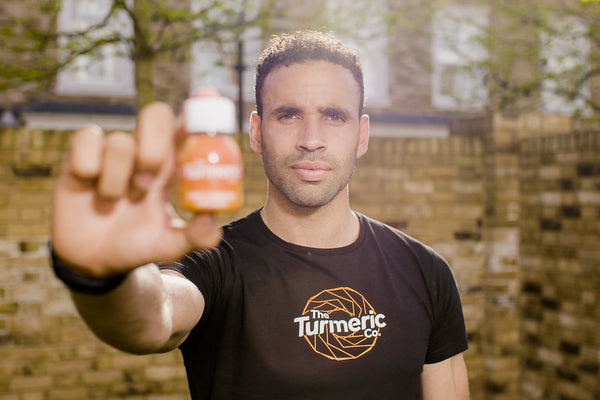
The Hal Robson-Kanu Guide To Fitness & Nutrition
Gain exclusive insight into habits that will make every day a healthy and fulfilling one.