


Turmeric and black pepper appear together in recipes, supplements, and shots for one reason, and it isn't flavour. It's that curcumin barely gets into your bloodstream without help.
Curcumin is poorly absorbed on its own. A 1998 study in Planta Medica gave healthy volunteers curcumin with and without 20mg of piperine, the pungent compound in black pepper, and measured a 2000% increase in curcumin bioavailability with the pepper. That single result is why the two ingredients are inseparable.
Key takeaways
- Curcumin is poorly absorbed, quickly processed by the gut wall and liver, and cleared by your digestive system quickly.
- Piperine slows that clearance, so more curcumin reaches your bloodstream.
- The human data comes from a small 1998 study using 20mg of piperine, and it's the study the whole category rests on.
- A pinch of pepper in cooking is not the same intervention, though it's still worth adding.

Why do turmeric and black pepper go together?
Because turmeric's active compound has an absorption problem, and pepper's active compound happens to solve it.
Curcumin is defined as the principal curcuminoid in turmeric root, the yellow pigment responsible for the colour and for most of the activity that's been studied. Its weakness is pharmacokinetic rather than biological. It dissolves poorly in water, it's rapidly modified in the gut wall and liver in a process called glucuronidation, and what survives is cleared quickly.
Piperine is the alkaloid that gives black pepper its heat. It inhibits some of the enzymes responsible for that rapid processing, and it appears to slow how fast the gut moves things through. The net effect is that more curcumin, in its usable form, stays in circulation for longer.
Neither compound changes what the other does. Pepper doesn't make curcumin more powerful. It gives your body the chance to see it at all.
| The pairing | What's actually going on |
|---|---|
| Turmeric alone | Curcumin is poorly absorbed and cleared rapidly |
| Turmeric with black pepper | Piperine slows the processing, so blood levels rise substantially |
| Turmeric with fat | Curcumin is fat soluble, so a little oil or fat helps carry it |
| Turmeric powder in hot water | Pleasant drink, minimal curcumin reaching the bloodstream |
| A pinch of pepper on a curry | Genuinely useful. The pepper side is easy to hit, the turmeric side isn't |
What the 1998 study actually found
A large increase in a small, well conducted study, and it's worth knowing its limits as well as its headline.
The Planta Medica work tested curcumin in rats first, where piperine raised bioavailability by 154%, and then in healthy human volunteers, where the effect was far larger. Given 2g of curcumin alone, serum levels were either undetectable or very low. Given the same 2g with 20mg of piperine, concentrations rose sharply from fifteen minutes onwards, and the authors reported a 2000% increase in bioavailability, with no adverse effects at those doses.
It's a small human study, and it measured blood levels rather than a health outcome. What it established is the mechanism, and that has held up: it's why every serious turmeric formulation either includes pepper or uses another way of getting curcumin across.
We'd rather present that plainly than repeat 2000% as though it were a fixed property of every turmeric product on a shelf. It's a specific measurement, from a specific pairing, at specific doses.
For a sense of scale on the turmeric side, EFSA has set an acceptable daily intake for curcumin of 3mg per kilogram of body weight per day, which works out at around 210mg for a 70kg adult.

How much black pepper do you actually need?
Less than you'd think, and more than a twist over your dinner.
Twenty milligrams of piperine is the amount used in the human study. Black pepper is roughly 5 to 9% piperine by weight, and a teaspoon of ground pepper weighs about 2.3g, so 20mg works out at a tenth to a sixth of a teaspoon. A decent pinch, in other words, taken at the same time as the turmeric.
So the pepper is the easy half. The hard half is the turmeric, since you'd need a serious daily quantity of root or powder alongside it, every day, for the pairing to mean anything. That's the gap a formulated product closes, by putting both sides in the right proportion in one place.
The relationship isn't all or nothing either. Adding pepper to a turmeric dish helps, even below trial amounts, and it costs nothing.
Very large amounts of piperine aren't a free lunch, though. The same enzyme inhibition that helps curcumin can affect how your body handles some medicines, so if you take regular prescription medication, mention a high-dose turmeric and pepper supplement to your GP or pharmacist. The NHS guidance on herbal medicines is the general rule of thumb here.
Does fat help as well?
It does, and it's the other half of the answer people forget.
Curcumin is fat soluble, so taking it with a meal containing some fat gives it a better chance of being carried across the gut wall. That's the reason golden milk is traditionally made with whole milk and a fat, and why turmeric in a curry with oil in the pan behaves differently from turmeric stirred into water.
Formulation is the third route, and it's where most of the recent work has gone: phospholipid complexes, nanoparticles, and liposomal preparations all aim at the same target from a different angle. We've covered how the formats compare in turmeric absorption and bioavailability, and how a shot compares with capsules and powder in turmeric shots vs capsules vs powder.
This is also the honest answer to why turmeric powder isn't the answer to a daily habit. Powder is a flavouring, wonderful in cooking, and it isn't a practical route to a meaningful daily amount of curcumin.
Where a daily shot fits
With the pepper already in the bottle, in the right proportion, every single time.
Every one of our seven blends carries the trade-secret BioMax Uptake Blend®, which includes black pepper, and it's tuned to each shot: black pepper and chilli in Raw Turmeric & XTRA Ginger, black pepper and cinnamon in Raw Turmeric & Vitamin C & D3, and black pepper, cinnamon, and thyme in Raw Turmeric & Ashwagandha. It's an elevated black pepper mix rather than plain ground pepper.
Raw Turmeric Original is the everyday one: a cold-crushed, whole watermelon-based blend at 30% raw turmeric root, with pineapple, lemon, magnesium, and vitamin C alongside the pepper mix.
That's the blend independent researchers at Nottingham Trent University used in the first clinical trial of these shots with elite footballers, two a day, which found lower inflammatory markers at 64 hours after a match and less soreness. We funded the research and had no hand in the results, and it's a small study in young athletes.
The takeaway
Turmeric and black pepper belong together because curcumin cannot do much from inside your gut. Piperine changes the arithmetic, and it's been measured in people rather than only argued for.
If you cook with turmeric, add pepper and a little fat, and you've done the sensible thing for nothing. If you want a dependable daily amount, choose a format where the pepper is already in the mix and in the right proportion, rather than hoping the pinch you added covers it.
That's what a shot is for. Raw Turmeric Original, first thing, with the pepper blend already in the bottle, is the least fiddly way to make the pairing a habit rather than an intention.
If you take regular prescription medication, have a bile duct or gallbladder condition, or you're pregnant, check with your GP or pharmacist before adding a concentrated turmeric supplement.
Frequently asked questions
Why is black pepper added to turmeric?
Because piperine, the compound that makes pepper pungent, slows the enzymes that process curcumin in your gut wall and liver. Curcumin is otherwise poorly absorbed and cleared quickly, so without pepper or another absorption technology, very little reaches your bloodstream.
How much black pepper should I take with turmeric?
The human study used 20mg of piperine, which is roughly a tenth to a sixth of a teaspoon of ground black pepper, taken at the same time as the turmeric. That part is easy. The harder part is getting a meaningful daily amount of turmeric alongside it, which is what a formulated product is for.
Does the 2000% figure mean my absorption goes up 2000%?
No. That was the increase measured in one small 1998 study, in healthy volunteers given 2g of curcumin with 20mg of piperine. It established the mechanism convincingly. It isn't a fixed number that applies to every turmeric product, dose, or person.
Can I just add pepper to turmeric powder at home?
You can, and it's genuinely better than turmeric alone. The limitation is the turmeric rather than the pepper: powder is a flavouring, and getting a meaningful daily amount of curcumin from it is impractical. Add pepper and fat to your cooking, and use a concentrated format if you want a reliable daily amount.
Does black pepper interact with medication?
It can, in concentrated amounts, because the same enzyme inhibition that helps curcumin also affects how some medicines are processed. Culinary pepper is not usually a concern. If you take regular prescription medication, mention any high-dose turmeric and pepper supplement to your GP or pharmacist.
Is there any way to absorb turmeric without pepper?
Yes. Curcumin is fat soluble, so taking it with fat helps, and several formulation approaches exist, including phospholipid complexes and liposomal preparations. Pepper remains the simplest and best studied route, which is why it's in almost every serious turmeric product.

Raw Turmeric Original Shot Box
Our Original Turmeric Shot packs a real punch thanks to a whopping 35g of fresh raw turmeric root used to make each shot.
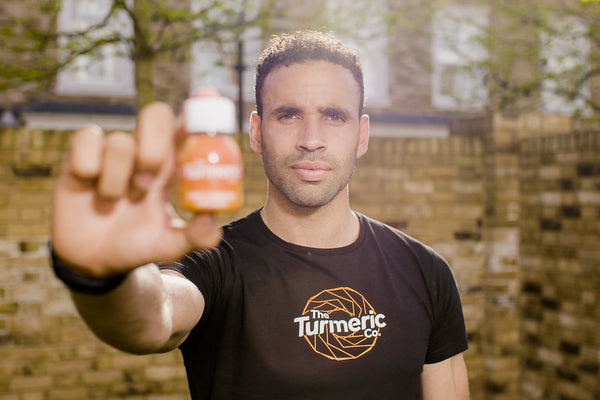
The Hal Robson-Kanu Guide To Fitness & Nutrition
Gain exclusive insight into habits that will make every day a healthy and fulfilling one.