


If your knees, hands or hips have started making themselves known in a way they never used to, you're not losing the plot, and it isn't simply "getting older" in some vague, unfixable sense.
There's a real, well-studied process behind it, sometimes nicknamed "inflammaging": low-level inflammation that quietly builds in the body from your mid-forties onwards, chipping away at cartilage and leaving joints stiffer and more reactive than they used to be.
The useful part is that, once you understand what's driving it, quite a lot of it is within your control...
The "inflammaging" effect: what's actually going on
Researchers use the term inflammaging to describe a chronic, low-grade inflammation that develops with age, even without any infection or injury to explain it.
A review in Frontiers in Medicine on inflammaging and degenerative joint disease describes how this background inflammation becomes one of the main drivers of conditions like osteoarthritis over time, working away in the background long before pain becomes noticeable.
It isn't a switch that flips at a certain birthday, more a slow build-up that tends to become impossible to ignore somewhere in your forties or fifties.

It's not just wear and tear
For years, joint pain past a certain age was written off as simple mechanical wear, like an old hinge. The picture is more layered than that.
Research on ageing and osteoarthritis shows that as cartilage breaks down, the fragments trigger an immune response, releasing inflammatory compounds that cause pain and swelling and encourage further breakdown, a cycle rather than a one-way slide. UCLA Health notes that pain which is worse in the morning, comes with visible swelling, or affects several joints at once tends to point towards inflammation rather than pure mechanical wear, which matters because the two respond differently to lifestyle changes.
The everyday habits that quietly turn up the inflammation
Several ordinary, easy-to-miss habits tend to add fuel to this over time.
Long stretches of sitting reduce circulation to the joints and let supporting muscles weaken. Diets heavy in ultra-processed food, refined sugar and refined oils have repeatedly been linked to higher inflammatory markers in the blood.
Poor sleep and chronic stress raise cortisol, which in the long run tends to promote rather than calm inflammation. None of these cause inflammaging on their own, but they tend to speed it up, which is also why they're some of the most useful places to intervene.

Why strength training matters more here than ever
There's another piece of this that rarely gets mentioned alongside inflammation: muscle.
From your forties onwards, the body starts losing muscle mass and strength at a noticeably faster rate, a process researchers call sarcopenia, and it tends to accelerate with each decade unless something actively counters it.
Less muscle around a joint means less support and shock absorption, so the joint itself ends up taking more of the load, which can make existing pain and stiffness worse. Strength training after 40 is one of the most effective ways to slow this down, and it doesn't need to mean heavy gym sessions: two or three short sessions a week with bodyweight moves or light weights is enough to make a real difference to how stable and supported your joints feel.
What actually helps, starting now
The good news is that inflammaging responds to the same everyday habits that support joint health at any age, they just carry more weight once you're in your forties and beyond.
It's been said before, but regular movement, an anti-inflammatory way of eating built around vegetables, whole grains, nuts and seeds, consistent sleep, and stress management all help take some of the heat out of that background inflammation. It seems too simple to be true but trust us, it works!
Turmeric is one plant remedy that has been researched specifically in this context: a 2025 systematic review and network meta-analysis of randomised controlled trials found that turmeric preparations significantly reduced pain and improved function in knee osteoarthritis compared with placebo. We use raw turmeric root, alongside black pepper to help the body absorb its curcumin, in our Raw Turmeric Original and Raw Turmeric & Ginger shots, rather than an isolated, processed tablet. For the fuller list of everyday habits worth building on, our guide to turmeric for joints goes into more depth.
Giving your joints a fair chance
None of this means resigning yourself to creaky knees as some sort of life sentence, and it doesn't mean overhauling everything overnight either. Inflammaging is a slow process, and the habits that help it are equally slow-acting, so the aim is consistency rather than intensity.
A short daily walk, a plate that leans more towards whole foods than packets, a proper bedtime, and turmeric given a few months to do its work will generally do more for a joint than any single dramatic change.
Forty-five isn't the finish line for feeling good in your body, it's just the point where paying a bit more attention starts to pay off.

Raw Turmeric Original Shot Box
Our Original Turmeric Shot packs a real punch thanks to a whopping 35g of fresh raw turmeric root used to make each shot.
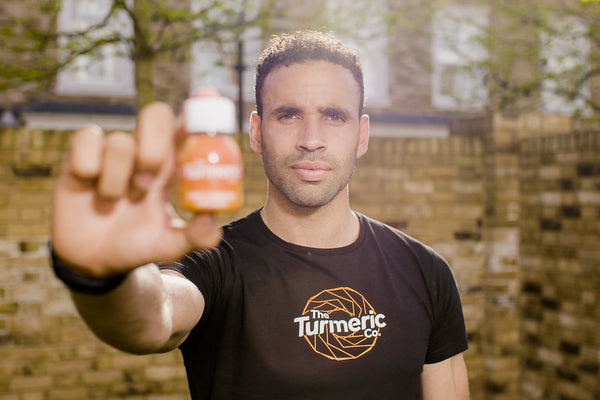
The Hal Robson-Kanu Guide To Fitness & Nutrition
Gain exclusive insight into habits that will make every day a healthy and fulfilling one.