


If your knees start grumbling the second you spot a staircase, you're not imagining it, and you're definitely not alone.
Stairs are basically the final boss for a lot of knees, and there's a proper reason why: a systematic review and meta-analysis found that climbing pushes 2.5 to 3.2 times your body weight through the kneecap, more than walking on the flat ever does.
So if you've been eyeing up the lift instead... your knees aren't being dramatic! Here's what's actually causing the ache, and what tends to help.
Why your knees single out stairs for punishment
Every step up asks your thigh muscles to yank your kneecap tight against the groove of your thigh bone, which keeps the joint stable but also racks up the pressure.
That's fine when your muscles are strong and the cartilage underneath is in good shape, but it turns uncomfortable fast if either one is having an off day.
Going down is usually worse than going up, since your knee has to control your whole body weight against gravity rather than just lift it, which is why plenty of people wince more on the way down than the way up.
And if it's genuinely only stairs that bother you, with the flat feeling totally fine, that's actually a helpful clue: it points to load and mechanics rather than anything more serious going on underneath.
The usual suspects behind stair pain
Top of the list is patellofemoral pain syndrome, basically the kneecap not gliding smoothly in its groove, which irritates the cartilage underneath.
It tends to sneak in after a sudden jump in activity, like taking up running or starting a new gym routine, rather than from one dramatic injury. Other possible culprits include chondromalacia patellae (softened cartilage under the kneecap), a meniscus tear, patellar tendinitis, or, for older knees, early osteoarthritis.
Weak hip muscles are a bigger deal than most people realise: when your hips can't hold your thigh steady, your knee tends to dip inward with every step, adding extra strain exactly where you don't want it. Tight hamstrings or calves, tired old trainers, and a sudden spike in walking or training can all pile on top of that, which is why stair pain usually creeps in rather than appearing overnight.

Fixing it from the ground up: strength beats rest
Because weak quads and hips cause so much of this, building strength usually beats sitting it out. Straight-leg raises, wall sits, step-ups on a low box, and side-lying hip exercises all build support around the knee without putting it through a full flight of stairs - start small but stay consistent!
Plenty of people notice a difference within a few weeks of sticking with it, though it's fair enough to take the lift or ease off stairs for a bit if things flare up sharply, then build back up gradually. A physiotherapist can spot exactly which muscles are slacking and put together a plan that's a lot more useful than generic advice off the internet, and often it only takes a short block of sessions to change how stairs feel day to day.
Small daily habits that take the edge off
Alongside the strengthening, a few simple habits help take the sting out day to day. An ice pack for 15 to 20 minutes after activity, kept over a cloth rather than straight on the skin, calms things down, while a warm compress beforehand loosens things up.
An anti-inflammatory way of eating, built around vegetables, whole grains, nuts and seeds, backs this up from the inside, especially alongside a healthy weight, since every extra pound adds roughly four pounds of load through the knee with each step.
Turmeric is worth having on your radar here too: a 2025 systematic review and network meta-analysis of randomised controlled trials found turmeric preparations significantly reduced standard pain and function scores in knee osteoarthritis compared with placebo, and a separate placebo-controlled trial of low-dose turmeric extract reported similar improvements over several weeks.

When it's time to stop self-diagnosing on Google
An occasional twinge on the stairs is normal enough and usually settles with the steps above. But NHS guidance is clear that you should see a GP if your knee gives way, locks, or won't take any weight at all, if there's obvious swelling, redness or warmth, or if the pain sticks around for weeks despite backing off aggravating activity. A short course of physiotherapy is often all it takes once someone's actually worked out what's going on, and getting it looked at early usually means a quicker, easier fix than waiting it out and hoping.
Stairs put your knees through more than almost anything else you do in an average day, so it makes sense they're the first to complain. Building strength around the joint, calming inflammation with food and turmeric, and using heat and cold sensibly all work far better as a team than any single fix on its own.

Raw Turmeric Original Shot Box
Our Original Turmeric Shot packs a real punch thanks to a whopping 35g of fresh raw turmeric root used to make each shot.
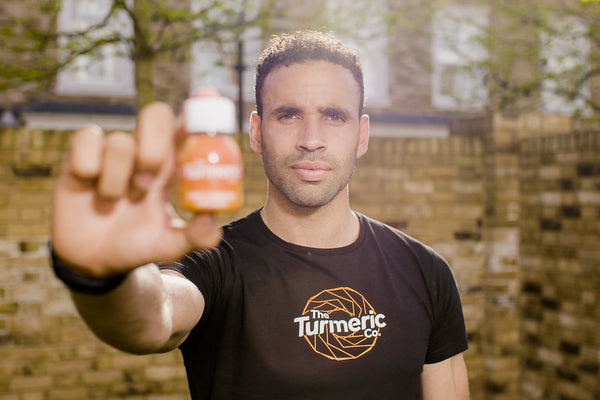
The Hal Robson-Kanu Guide To Fitness & Nutrition
Gain exclusive insight into habits that will make every day a healthy and fulfilling one.