


Press your finger gently into your cheek and watch how quickly it springs back - that's elasticity in action.
Skin elasticity is your skin's ability to stretch and then snap back into place, and it depends on two different proteins, not just collagen.
Collagen gives skin its structure, but it's a separate protein called elastin that gives skin its "bounce." Understanding this distinction matters, because it changes what actually helps: some approaches support collagen, some support elastin, and the most effective routines address both.
What actually gives skin its elasticity?
Collagen and elastin are both made by the same skin cells, called fibroblasts, but they play very different roles. Research describes collagen as responsible for tensile strength - it's the scaffolding.
Elastin, on the other hand, is what gives skin its stretch-and-recoil quality, the reason skin looks plump and springy rather than stiff or papery.
Here's the twist: these two proteins age very differently. Collagen can be rebuilt throughout life, but elastin production slows dramatically after adolescence and barely renews itself afterwards.
That's part of why elasticity loss can feel more permanent than other signs of ageing - your skin isn't just making less of it, it's working with what it was given decades ago.

What causes elasticity to decline?
A handful of everyday factors quietly chip away at both collagen and elastin over time:
- Oxidative stress from pollution and UV exposure
- Chronic low-grade inflammation, which interferes with fibroblast activity
- Natural ageing, as fibroblast output gradually slows
- Nutrient gaps - particularly in vitamin C, which is essential for building new collagen
None of these act alone; they tend to compound each other, which is why elasticity often declines gradually rather than all at once. It's less a single event and more the sum of thousands of small, everyday stressors.
Turmeric for skin elasticity: what does the research say?
This is where turmeric's active compound, curcumin, gets genuinely interesting.
Laboratory research on human skin cells found that curcumin increased production of tropoelastin and fibrillin-1 (the two building blocks of elastin fibres) suggesting it may support the skin's elastic network specifically, not just collagen.
Separately, curcumin has also been studied for its ability to stimulate fibroblasts themselves - the cells responsible for producing both proteins in the first place.
It's worth being honest about the caveats: this research is largely at the cell-culture stage rather than large-scale human trials, so the fair takeaway is that turmeric may support elasticity as part of a wider routine, rather than acting as a standalone fix.

Does vitamin C help collagen production - and does that affect elasticity?
Yes, and this is one of the more settled corners of the science. Vitamin C is a required cofactor in collagen synthesis - without it, the body simply can't stabilise new collagen molecules properly, no matter how much raw material is available.
Since elasticity depends on a healthy balance of both collagen and elastin, keeping vitamin C intake steady is one of the simplest, most evidence-backed things you can do for your skin. Good plant-based sources include peppers, citrus fruit, kiwi and berries - or a daily Raw Turmeric & Vitamin C+D3 shot if you'd rather not think about it every morning.
A simple, plant-based routine for supporting elasticity
The good news is that supporting elasticity doesn't require an elaborate routine - just consistency with a few key habits:
- Eat a colourful variety of fruit and vegetables daily for a broad spread of antioxidants and vitamin C
- Protect skin from UV exposure, one of the fastest ways to damage both collagen and elastin fibres
- Stay consistently hydrated, since well-hydrated skin supports the flexibility of the elastic network
- Manage chronic inflammation through diet and lifestyle rather than relying on any single ingredient
- Consider a daily Raw Turmeric & Pro-Collagen shot, combining raw turmeric with plant-based collagen support and vitamin C for a consistent, food-first approach
The takeaway
Skin elasticity is about more than collagen alone - elastin plays an equally important, and often overlooked, role in how skin stretches and recovers.
Turmeric's curcumin content has been studied to suggest it may support the fibroblast activity behind both proteins, while vitamin C has a proven, direct role in collagen formation. Together, folded into a consistent, whole-food routine, they give your skin's elastic network the best possible support to keep doing its job - quietly, and for the long haul!
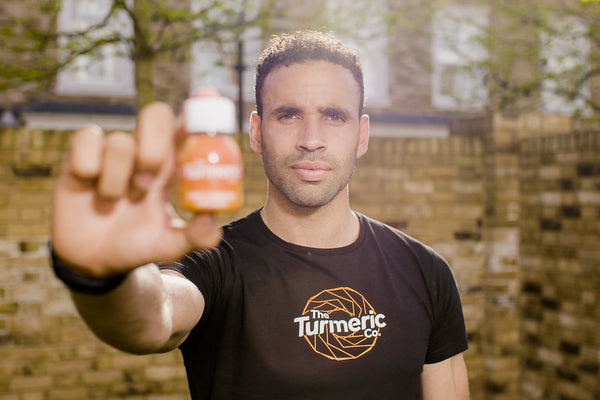
The Hal Robson-Kanu Guide To Fitness & Nutrition
Gain exclusive insight into habits that will make every day a healthy and fulfilling one.