


The best time for turmeric is the one you'll keep, and for most people that's first thing in the morning.
No strong evidence says one hour works better than another, so the best time is the one you'll stick to. For building a daily habit, first thing in the morning is hard to beat, because it's done before the day gets in the way. Pair it with, or follow it with, a breakfast containing a little fat and black pepper, since curcumin is fat-soluble and absorbs better in that company.
People often ask whether turmeric works better in the morning or at night, hoping there's an optimal window. The truthful answer is a little less exciting, and a lot more useful: what matters far more than the time on the clock is that you take it regularly, and with food. Here's how to make that work for you.
Key takeaways
- For building a daily habit, first thing in the morning is the easiest slot to protect.
- Consistency matters most: anchor turmeric to a moment you won't skip.
- Have it with, or just before, a meal with a little fat and black pepper to help absorption.
- Morning, evening or around training can all work, but a fixed morning ritual is the one most people keep.
Is there a best time to take turmeric?
There isn't strong evidence that a specific time of day makes turmeric more effective.
What the research does point to is the value of consistency and of taking curcumin in the right company, meaning with food and an absorption aid. So rather than chasing a perfect hour, the goal is to anchor turmeric to a moment in your day you won't skip.
Pick a time you can repeat without thinking about it. That's the real optimisation.
Should you take turmeric with food?
If there's one timing rule worth following, it's this one.
Curcumin is fat-soluble, so taking turmeric alongside a meal containing a little fat helps your body absorb more of it. A review in the journal Nutrients notes that dietary fats can affect how well curcumin dissolves and absorbs, and suggests pairing turmeric with lecithin-rich foods such as eggs or vegetable oils. Black pepper helps as well, since piperine improves curcumin absorption considerably. Taking turmeric with food also tends to be gentler on the stomach than taking it on an empty one.
So the best "time" is really a mealtime.
What about an empty stomach?
You'll sometimes read that shots must be taken on an empty stomach so the nutrients rush in faster. That part is a myth, but taking your shot first thing, before breakfast, is still a great way to anchor the habit.
Here's how to get the best of both. Curcumin is fat-soluble, so it absorbs better with a little fat around it. Have your morning shot first thing to lock in the routine, then follow it with a breakfast that includes some fat, and you get the easy habit and the absorption help together. A concentrated raw shot can feel quite intense on a completely empty stomach for some people, so if that's you, taking it alongside breakfast works just as well.
Timing is the small detail, though. The British Dietetic Association makes the point that the overall quality of your diet matters more than any single supplement, so the aim is to fit turmeric around meals you're already eating rather than build your day around it.
Is it better to take turmeric in the morning?
For most people, morning is the easiest slot to protect, which is why it's the one we'd recommend.
Taken first thing, turmeric is done before the day can crowd it out, and there's a certain appeal to starting with something you're doing for yourself. A raw shot such as Raw Turmeric Original is an easy one to build in next to your coffee or breakfast, whether you have it just before your first meal or alongside it.

The real advantage of mornings is consistency. You're far less likely to forget before the day runs away with you, and a fixed morning cue is what turns turmeric into a habit that sticks.
What about taking turmeric at night?
Others find the end of the day easier to keep, and that's just as valid.
Taken with dinner, turmeric still gets the food and fat that help absorption, and an evening ritual can be a pleasant way to wind down. Some people who like a calmer evening routine reach for Raw Turmeric & Ashwagandha, which pairs the root with an adaptogen traditionally taken as part of a relaxing wind-down.
Whether it's morning or evening matters far less than whether it's every day.
If you train
If you're active, you might prefer to tie turmeric to your training routine.
Plenty of people take it around exercise as part of a recovery habit, alongside food afterwards. If you train, Raw Turmeric & Beetroot is a natural fit, our performance-focused shot that pairs the root with beetroot, while a ginger-forward option like Raw Turmeric & Ginger suits a recovery routine. The point isn't that a workout triggers some special effect, it's that training gives you a reliable daily cue to hang the habit on.
Here's how the main options compare:
| Timing | Why it works | Good for |
|---|---|---|
| With breakfast | Slots into an existing routine and is easy to remember | Most people |
| With dinner | Still gets the food and fat that help absorption, and makes a pleasant wind-down | Evening routines |
| Around training | A reliable daily cue, taken with food afterwards | Active people |
What matters more than timing
Step back, and the priorities are clear.
Daily consistency comes first. Taking turmeric with food and a little fat comes second. Including black pepper or another absorption aid comes third. Get those three right and the exact hour barely registers.
The takeaway
If you want a simple rule, make turmeric a first-thing-in-the-morning ritual, follow it with a breakfast that has a little fat and some black pepper, and keep it daily.
The best schedule is the one you'll still be following in three months, because with turmeric, that consistency is what counts.
Frequently asked questions
When is the best time to take turmeric?
There's no single magic hour, so the best time is the one you'll keep. For building a daily habit, first thing in the morning is the easiest slot to protect. Our turmeric shots come in a ready-to-drink formula (black pepper and fat intact!), but if you’re opting for turmeric tablets or liquids then you would need to have it with a breakfast that contains a little fat and some black pepper to help absorption.
Should I take turmeric in the morning or at night?
Both can work, but morning has the edge for habit-building, since it's done before the day gets in the way. An evening dose still gets the food and fat that help absorption, so if that's the time you'll actually keep, it's a fine choice. What matters most is doing it every day.
Should turmeric be taken on an empty stomach?
A shot first thing, before breakfast, is a great habit anchor and perfectly fine. For absorption, though, curcumin is fat-soluble, so following your shot with a breakfast that has a little fat gives your body more to work with. Food also tends to be gentler on the stomach than a concentrated shot on its own.
Does turmeric work better with food?
Yes. Curcumin is fat-soluble, so pairing turmeric with a meal that has some fat, plus black pepper, helps your body absorb more of it than taking it with water alone.
How often should you take turmeric?
Daily is the goal. Turmeric rewards steady, regular intake far more than an occasional large dose, so a modest food-like amount each day does more than a big hit now and then. Anchoring it to a meal you never skip is the easiest way to keep it consistent.

Raw Turmeric Original Shot Box
Our Original Turmeric Shot packs a real punch thanks to a whopping 35g of fresh raw turmeric root used to make each shot.
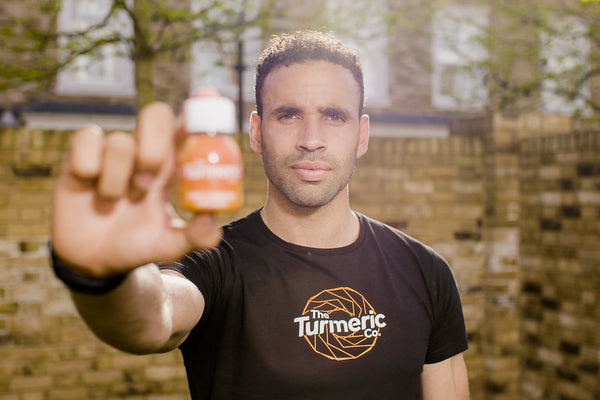
The Hal Robson-Kanu Guide To Fitness & Nutrition
Gain exclusive insight into habits that will make every day a healthy and fulfilling one.